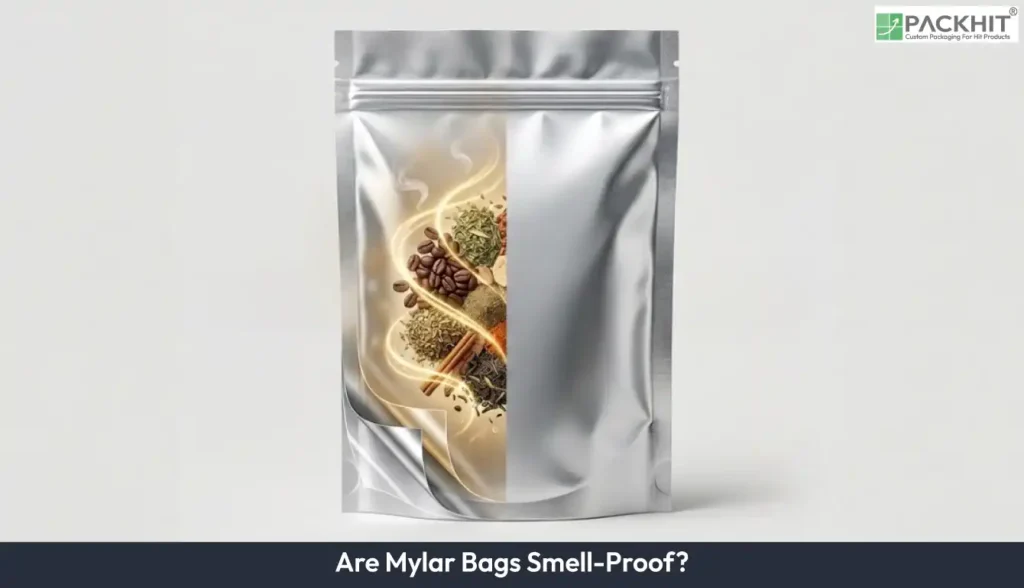
Custom mylar bags are smell-proof and use multilayer construction, including foil or high-barrier polymer films and heat-sealed LLDPE or polypropylene closures, to restrict odor diffusion and leakage. Continuous aluminium foil, EVOH or PVDC, SiOx or AlOx coatings, and low-odor sealants affect barrier performance, while creases, punctures, humidity, and weak seals reduce it. Odor retention ranges from hours to days, days to weeks, or months to years according to the laminate, product volatility, temperature, headspace, and seal integrity. Activated-carbon liners, vacuum packing, inert- gas flushing, double pouches, and rigid secondary containers address remaining odor paths, so manufacturers must test the complete package under actual storage and transport conditions.
Mylar bags contain odors only when their laminate, seams, zippers, and closures remain intact; heat-seal defects, contamination, punctures, and aging can create leakage paths. Recycling depends on construction, since mono-material films are easier to process than foil, metallized, carbon- lined, or multilayer laminates, while seal inspection, home odor testing, carbon liners, vacuum sealing, and double-bagging help verify and improve containment.
- What are Smell-Proof Mylar Bags?
- How Do Odors Travel Through or Out of a Mylar Pouch?
- Which Material and Structural Options Reduce Odor Transmission in Mylar Bags?
- Continuous Aluminium Foil Laminate
- High-barrier Polymers (EVOH, PVDC)
- Inorganic Barrier Coatings (SiOx, AlOx)
- Inner Sealant Choice (LLDPE, Metallocene PE)
- How Long Can Mylar Bags Keep Odors Contained?
- Mylar Bags and Complementary Odor-Control Technologies
- How Do Seams and Closures Fail to Keep Odors Contained in Mylar Bags?
- Do Mylar Bags Have Recycling and Environmental Trade-offs?
- Are Mylar Bags Smell-Proof for Cannabis or Herbs?
- Will a Metallized Mylar Bag Stop a Dog From Detecting an Odor?
- Can I Make an Ordinary Mylar Bag Smell-Proof?
- How Long Will the Odor Stay Contained in a Foil-laminated Mylar Pouch?
- Do Smell-Proof Mylar Bags Have Labeling Standards that Can be Trusted?
- How Do Manufacturers and Labs Test Smell-Proof Performance?
What are Smell-Proof Mylar Bags?
Smell-proof Mylar bags are sealed, multilayer pouches that limit the passage of odor molecules from the contents to the surrounding air. Their polyester film supplies strength, while an aluminum foil or high-barrier polymer layer restricts gas and odor transfer. The inner LLDPE or polypropylene sealant forms the closure, so odor control depends on the barrier material, seal quality, and storage conditions. No pouch is completely odor-proof; therefore, manufacturers must test the finished package against the product and required detection level.
How Do Odors Travel Through or Out of a Mylar Pouch?
Mylar pouches restrict odor transmission through their barrier film, inner polymer layer, and sealed closure, but they are not automatically completely smell-proof.
- Barrier layer: A metallic or dense inorganic coating limits odor diffusion.
- Polymeric layer: A low-solubility, low-diffusion layer restricts aromatic molecules.
- Adsorption media: Added media trap volatile compounds and reduce headspace partial pressures.
- Closures and seals: Engineered seals limit conductive and convective leakage.
- Validation: Controlled testing confirms odor reduction when these features work together.
Which Material and Structural Options Reduce Odor Transmission in Mylar Bags?
The material and structural options that reduce odor transmission in Mylar bags include continuous aluminium foil laminate, high-barrier polymers, inorganic barrier coatings, and inner sealant choice.
Continuous Aluminium Foil Laminate
Continuous aluminium foil and inorganic barrier coatings can substantially improve barrier performance, but results depend on the complete laminate, layer thickness, defects, seals, and test conditions. It suits long-term storage and transport, with reduced recyclability and sensitivity to creasing and puncture as trade-offs.
High-barrier Polymers (EVOH, PVDC)
High-barrier polymers, including EVOH and PVDC, reduce oxygen and VOC permeability in laminates when protected from humidity. They resist diffusion from polar and semi-polar odorants, but moisture can reduce performance; the laminate therefore requires a moisture-protective outer layer and controlled processing.
Inorganic Barrier Coatings (SiOx, AlOx)
Inorganic barrier coatings (SiOx, AlOx) form ceramic-like layers on PET, raising barrier performance without metal foil. Coating thickness typically ranges from 50 to 200 nanometres but can vary according to the coating material, required odor-barrier performance, manufacturing process, and intended product use; these layers reduce gas and VOC transmission while preserving optical properties. Repeated flexing can crack coatings, while abrasion reduces barrier performance.
Inner Sealant Choice (LLDPE, Metallocene PE)
Inner sealant selection (LLDPE, metallocene PE) determines heat-seal quality and the integrity of the package closure.
Use low-odor, low-extractable sealants to reduce interfacial diffusion and improve seal strength; ensure appropriate seal width and temperature control during sealing to avoid cold spots and micro-gaps.
How Long Can Mylar Bags Keep Odors Contained?
Mylar bags can retain odors for different lengths of time, as listed below.
- Short-term containment (hours–days): Metallized BoPET pouches limit detectable odor for hours to days when heat seals are continuous, and product volatility is moderate; examples: roasted coffee, dried herbs.
- Medium-term containment (days–weeks): Foil-laminated or inorganic-coated laminates reduce VOC permeation enough to contain odors for days to weeks under ambient storage if seals remain intact and temperature is controlled; examples: terpenes in cannabis, aromatic oils.
- Long-term containment (months–years): Continuous aluminium foil laminates or rigid metal canisters maintain low external VOC flux for months to years when seals are hermetic and internal headspace concentrations are low; examples: archival materials, long-term warehousing of low-volatility compounds.
Outcome depends on seal integrity, temperature, headspace concentration, and reclosure frequency; add activated-carbon liners, vacuum packing, or double containment if lower external emission is required.
Note: Containment time varies substantially with the laminate, seal integrity, contents, temperature, headspace, and handling; establish any expected duration by testing the complete package under defined conditions.
Mylar Bags and Complementary Odor-Control Technologies
Mylar bags reduce odor transfer, but carbon, vacuum, gas flushing, and secondary packaging address additional leakage paths. A laminated Mylar pouch limits diffusion through the film; the seal, closure, headspace, and product condition still affect odor retention.
- Activated-carbon liners: Adsorb volatile odor molecules on porous carbon surfaces. Adsorption capacity depends on carbon surface area, pore-size distribution, loading, contact time, and humidity. Use a carbon liner when odor removal inside the package matters, rather than relying on film resistance alone.
- Vacuum packing: Removes part of the headspace and lowers the initial amount of volatile material available for leakage. Use vacuum packing when the product tolerates reduced pressure and oxygen exposure must also be limited. A vacuum does not repair a weak seal or stop permeation through an unsuitable film.
- Inert-gas flushing: Replaces air with nitrogen or another compatible gas, reducing oxygen concentration and changing the headspace conditions that affect volatile release. Use gas flushing when oxidation control matters or when product compression from vacuum packing is undesirable.
- Double packaging: Places a sealed high-barrier inner Mylar pouch inside a second sealed pouch. Two independent seals and film barriers reduce the chance that one pinhole, channel leak, or closure defect reaches the outside environment.
- Rigid secondary packaging: Adds a metal tin, hermetic container, or other low-permeability enclosure around the Mylar bag. This layer protects against puncture, abrasion, compression, and odor release during transport and storage.
Test the complete package, not the Mylar film alone. A practical evaluation includes the selected film structure, seal width, closure type, carbon component, headspace treatment, storage temperature, humidity, and transport handling.
How Do Seams and Closures Fail to Keep Odors Contained in Mylar Bags?
Seams, zippers, and reclosure systems are the primary leakage routes because they permit convective escape and mechanical breaches that bypass the laminate barrier.
- Incomplete heat seals: lack of fusion along the seal line; examples: cold spots and contaminant inclusion; result: micro-gaps that allow advective leaks.
- Zipper interface gaps: loss of compression or particulate fouling; examples: resealable zippers and interlocking profiles; result: repeated-use gaps that increase leakage.
- Seal contamination: trapped oils, powders, or moisture; examples: product residue and dust; result: interrupted molecular contact and reduced seal integrity.
- Punctures and pinholes: mechanical damage from handling or sharp items; examples: needle punctures and jagged product edges; result: direct open paths for odor escape.
- Seal aging and creep: polymer relaxation and loss of compression over time; examples: temperature cycling and plasticizer migration; result: growing permeation and higher leak probability.
Control measures: use continuous heat seals for single-use applications, add a secondary overwrap or rigid secondary packaging, incorporate activated-carbon liners, and perform visual and pressure inspections; use heat sealing if repeated zipper reclosure creates unacceptable leak risk.
Do Mylar Bags Have Recycling and Environmental Trade-offs?
Mono-material polyester films (untreated BoPET) enter mechanical recycling more easily. Multilayer laminates combine aluminium foil, EVOH, adhesives, and polyolefin sealants and hinder recycling. Metallized and coated films, plus carbon or foil liners (for example, activated-carbon liners), complicate sorting and reprocessing and often require energy recovery or specialized recycling routes. Select foil-based or mono-structure solutions if recyclability is a priority, and choose multilayer laminates only when barrier performance justifies the reduced recycling potential.
Are Mylar Bags Smell-Proof for Cannabis or Herbs?
Yes, Mylar constructions are effectively smell-reducing for cannabis and aromatic herbs, but the outcome depends on laminate type (foil versus metallized), seal quality, and reclosure method; for consistent odor suppression, choose foil-laminated pouches or add an activated-carbon liner.
Will a Metallized Mylar Bag Stop a Dog From Detecting an Odor?
No, Mylar bags are not guaranteed to be smell-proof against trained detection dogs. They can reduce odor transmission, but a trained detection dog may identify a target scent that people or routine instruments do not detect, especially after training against that specific odor. Performance depends on the film structure, seal quality, contents, temperature, and handling, so assess the package through controlled odor-permeation and canine-detection testing rather than assuming any barrier system is reliable.
Can I Make an Ordinary Mylar Bag Smell-Proof?
No, an ordinary Mylar bag cannot guarantee odor-proof storage. An activated-carbon liner, vacuum packing, and a second sealed foil overwrap reduce odor transfer; heat-seal the pouch rather than relying on repeated zipper reclosure.
How Long Will the Odor Stay Contained in a Foil-laminated Mylar Pouch?
Containment time ranges from days to months, depending on volatility, storage temperature, and whether the pouch remains unopened; continuous foil laminates slow diffusional transfer to a practical minimum for many volatile compounds over storage periods typical for retail and short-term warehousing.
Do Smell-Proof Mylar Bags Have Labeling Standards that Can be Trusted?
No, Mylar bags are not universally smell-proof. Odor containment depends on the film structure, seal quality, closure, and product concentration. A “smell-proof” label does not prove a defined containment level, so check applicable market requirements and request the supplier’s test method, headspace data, and independent laboratory results.
How Do Manufacturers and Labs Test Smell-Proof Performance?
Laboratories quantify odor containment using instrumental and sensory protocols designed to measure VOC escape and detectability.
Common laboratory procedures and metrics:
- Dynamic headspace analysis with thermal desorption and GC‑MS: measures specific VOC species in external headspace after controlled equilibration.
- Solid-phase microextraction (SPME) followed by GC‑MS: extracts representative volatiles from headspace without active purge for comparative assessment.
- Sensory detection panels: trained human assessors perform blinded sniff tests to determine time-to-detection and perceived intensity; results expressed as detection incidence or intensity scale values.
- Permeation-cell measurements: measure steady-state flux of a surrogate compound through a film specimen under a defined concentration gradient, yielding mass-per-area-per-time metrics.
- Canine or electronic-nose trials: applied when sensitivity to trace odorants is essential; protocols use controlled training samples and detection-time endpoints.
Note: Possible evaluation methods include headspace, permeation, sensory, or other protocols selected for the product and test objective; laboratories should define conditioning, temperature, exposure time, sampling, and detection criteria for the specific package.