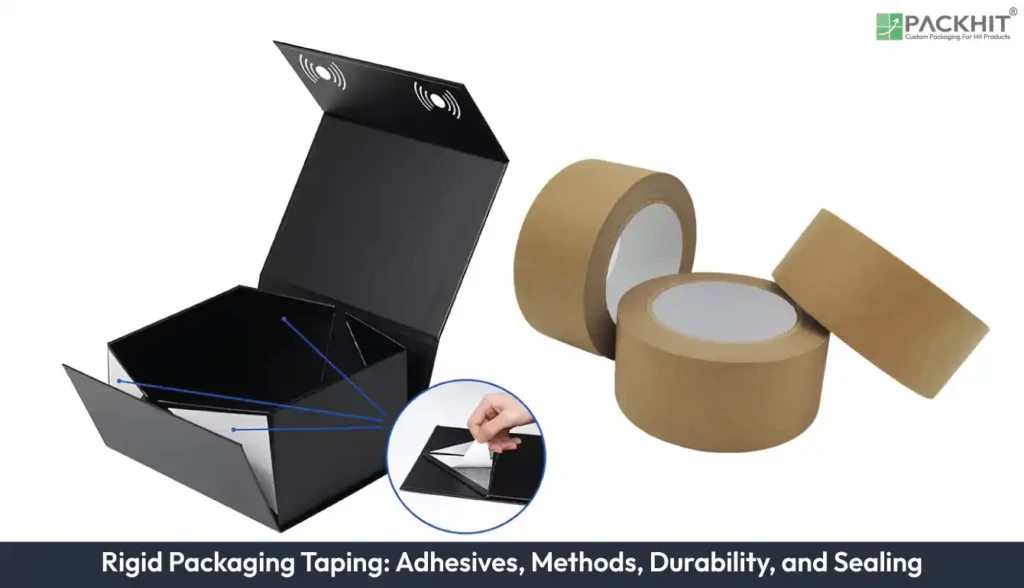
Rigid packaging taping uses adhesive-backed tapes to seal, reinforce, or protect materials such as corrugated fiberboard, chipboard, and molded pulp. Common adhesive types include pressure-sensitive, water-activated, and hot-melt systems, which may be applied manually, semi-automatically, or with automated equipment.
Sealing performance depends on factors such as adhesive type, substrate compatibility, surface condition, application method, temperature, humidity, and handling demands. Selecting suitable materials and application settings can help support the packaging requirements of products ranging from lightweight consumer goods to heavier industrial items.
- What is Rigid Packaging Taping?
- Adhesives Used in Rigid Packaging Tapes
- How are Tapes Applied to Rigid Packaging?
- Factors that Influence the Durability of Rigid Packaging Taping
- How Does Rigid Packaging Taping Achieve Effective Sealing?
- What Can Cause Tape Seals to Fail on Rigid Packaging?
- What to Consider When Choosing a Rigid Packaging Taping Method?
What is Rigid Packaging Taping?
Rigid packaging taping refers to the process of using adhesive-backed tapes to seal, reinforce, or protect rigid packaging materials. These materials, including corrugated fiberboard, chipboard, and molded pulp, are designed to provide structural integrity and secure closure for products during transit and storage. The taping process can help rigid packaging remain closed and intact under expected handling and environmental conditions when the tape, substrate, and application method are properly matched. Depending on the packaging design and use conditions, taping may also support product protection and tamper evidence.
Adhesives Used in Rigid Packaging Tapes
Adhesives used in rigid packaging tapes are engineered to provide strong bonding, resistance to environmental stressors, and compatibility with various packaging substrates. The primary adhesive types include pressure-sensitive adhesives (PSAs), water-activated adhesives (WAAs), and hot-melt adhesives (HMAs). Each type exhibits distinct properties tailored to specific packaging requirements.
Pressure-Sensitive Adhesives (PSAs)
PSAs are non-reactive adhesives that form bonds under light pressure without requiring activation by water, heat, or solvents. These adhesives are typically composed of elastomers, tackifiers, and plasticizers, which provide immediate adhesion to surfaces. PSAs are widely used in carton sealing tapes due to their ease of application and compatibility with automated taping systems. However, their performance may degrade under extreme temperatures or high humidity.
Water-Activated Adhesives (WAAs)
WAAs, commonly used in gummed paper tapes, require moisture to activate their bonding properties. These adhesives are often starch-based, offering strong adhesion to corrugated and kraft paper surfaces. WAAs are particularly valued for their tamper-evident sealing capabilities, as the bond becomes inseparable from the substrate once dried. However, their reliance on water activation necessitates controlled application environments.
Hot-Melt Adhesives (HMAs)
HMAs are thermoplastic adhesives applied in molten form and solidify upon cooling. These adhesives are composed of polymers such as ethylene-vinyl acetate (EVA) or polyolefins, combined with tackifiers and stabilizers. HMAs are favored for their rapid bonding, high shear strength, and resistance to mechanical stress. They are commonly used in high-speed packaging lines but may exhibit reduced performance in high-temperature storage conditions.
How are Tapes Applied to Rigid Packaging?
The application of tapes to rigid packaging involves various methods, each optimized for specific operational requirements, packaging materials, and production scales. These methods include manual application, semi-automated systems, and fully automated taping machines.
- Manual Application: Manual application involves the use of handheld tape dispensers to apply tape to packaging surfaces. This method is suitable for low-volume operations or irregularly shaped packages. While cost-effective, manual application is labor-intensive and may result in inconsistent tape placement.
- Semi-Automated Systems: Semi-automated systems combine manual feeding of packages with mechanized tape application. These systems improve consistency and speed compared to manual methods, making them ideal for medium-volume operations. Adjustable tension controls and cutting mechanisms enhance the precision of tape application.
- Fully Automated Taping Machines: Fully automated taping machines are designed for high-volume packaging lines, where speed and consistency are paramount. These machines integrate conveyor systems, sensors, and programmable logic controllers (PLCs) to apply tape with minimal human intervention. They are capable of handling various box sizes and can apply tape to both the top and bottom seams simultaneously.
Factors that Influence the Durability of Rigid Packaging Taping
The durability of rigid packaging taping is influenced by a combination of adhesive properties, environmental conditions, and mechanical stresses encountered during handling and transit. Key factors include adhesive cohesion, substrate compatibility, temperature resistance, and moisture tolerance.
Adhesive Cohesion and Tack
Cohesion refers to the internal strength of the adhesive, which prevents it from splitting under stress. Higher adhesive cohesion can help the tape resist splitting under handling stress. Tack, on the other hand, determines the adhesive’s initial bonding strength. Both properties must be balanced to achieve optimal durability.
Substrate Compatibility
The compatibility of the adhesive with the packaging substrate significantly affects bond strength. For instance, adhesives designed for kraft paper may not perform well on glossy or coated surfaces. Adhesive-substrate compatibility directly affects bond performance over time.
Environmental Resistance
Rigid packaging tapes must withstand environmental stressors such as temperature fluctuations, humidity, and UV exposure. For example, PSAs may lose adhesion in cold storage environments, while WAAs may degrade in high-humidity conditions. Testing under expected temperature and humidity conditions can help assess how the tape is likely to perform in use.
How Does Rigid Packaging Taping Achieve Effective Sealing?
Effective sealing in rigid packaging taping is achieved through the interplay of adhesive strength, tape tension, and surface preparation. Proper sealing ensures that the package remains closed during transit, prevents contamination, and provides tamper evidence.
- Adhesive Strength: The adhesive must provide sufficient bonding strength to resist peeling and shear forces. This is particularly important for packages subjected to stacking or vibration during transportation. Adhesive formulations are often tailored to meet specific load-bearing requirements.
- Tape Tension: The tension applied during tape application affects the uniformity of the bond. Excessive tension may cause the tape to lift or tear, while insufficient tension may result in loose seals. Automated systems often include tension control mechanisms to ensure consistent application.
- Surface Preparation: Dust, grease, moisture, and surface texture can affect adhesive performance. Cleaning or priming may improve bonding where the substrate and adhesive system require it.
What Can Cause Tape Seals to Fail on Rigid Packaging?
Tape seals may fail when the adhesive is not compatible with the packaging surface, when dust or moisture interferes with bonding, or when the tape is applied with unsuitable tension. Temperature changes, humidity, repeated handling, and package movement can also affect seal performance. Identifying these conditions helps explain why tape selection and application method should be matched to the packaging material and expected storage or transit environment.
What to Consider When Choosing a Rigid Packaging Taping Method?
Manufacturers should evaluate the packaging material, adhesive compatibility, package weight, storage and transit conditions, production volume, and sealing requirements before selecting a tape and application method. For example, a low-volume operation may suit manual taping, while larger production runs may benefit from semi-automated or automated systems. The adhesive should also be matched to the substrate and expected temperature, humidity, and handling conditions to support reliable sealing performance.
