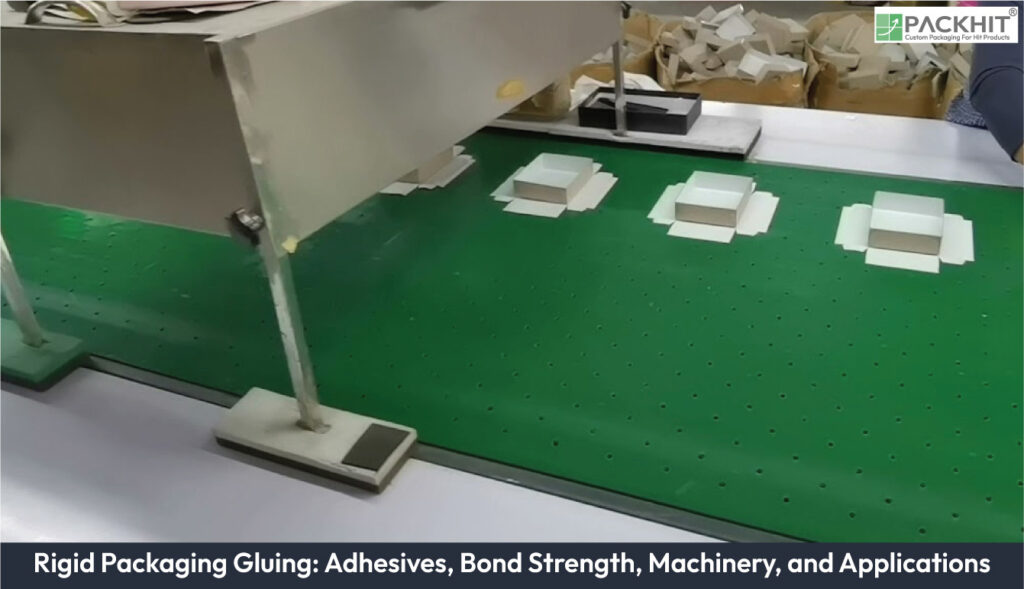
Rigid packaging gluing integrates versatile adhesives, precise machinery, and advanced techniques to deliver durable, efficient, and aesthetic packaging solutions across industries. It employs adhesive types such as hot melt, water-based, solvent-based, and pressure-sensitive adhesives to cater to diverse substrates and environmental conditions. Bond strength is achieved through thorough surface preparation, optimized adhesive application, and controlled curing processes, with strength validated by tensile, shear, and peel tests. Machinery like hot melt applicators, roller coaters, spray systems, and labeling machines enhances production speed and accuracy, adapting to industrial, consumer goods, luxury, and specialty packaging applications. Environmental factors such as temperature, moisture, and chemical exposure are carefully managed to ensure adhesive performance, while challenges like substrate variability and regulatory compliance are mitigated through innovation and quality control practices.
- What Adhesives are Used in Rigid Packaging Gluing?
- How is Bond Strength Achieved and Measured in Rigid Packaging Gluing?
- Machinery Used in Rigid Packaging Gluing
- Applications of Rigid Packaging Gluing
- Challenges in Rigid Packaging Gluing
- How do Environmental Factors Influence Rigid Packaging Gluing?
- How to Choose an Adhesive and Gluing Process for Rigid Packaging?
What Adhesives are Used in Rigid Packaging Gluing?
Adhesives used in rigid packaging gluing are categorized based on their chemical composition, bonding mechanisms, and application suitability. The primary adhesive types include:
Hot Melt Adhesives
Thermoplastic polymers activated by heat, offering rapid bonding and high initial tack. These adhesives are primarily used for paperboard and corrugated packaging due to their fast curing times and their compatibility with high-speed, automated machinery. Their excellent thermal stability makes them suitable for applications requiring temperature resilience.
Water-Based Adhesives
Formulated with synthetic or natural polymers dispersed in water, water-based adhesives are designed to provide strong bonds for porous substrates like paper and cardboard. These adhesives are environmentally friendly, easy to clean, and ideal for packaging solutions that prioritize sustainability. They work effectively in scenarios where eco-conscious practices are a priority.
Solvent-Based Adhesives
Solvent-based adhesives utilize volatile organic compounds (VOCs) as carriers, delivering high bond strength and durability for non-porous surfaces. These adhesives are particularly suited for applications requiring resistance to harsh chemicals or environmental exposure. However, their use is subject to regulatory compliance due to environmental and safety concerns.
Pressure-Sensitive Adhesives (PSAs)
PSAs are engineered for applications requiring repositionability or peelable bonds. These adhesives are commonly used in specialty packaging scenarios, including labels, tamper-evident seals, and custom closures. Their versatility makes them indispensable for packaging solutions demanding flexibility and precision.
Adhesive selection depends on substrate compatibility, production speed, environmental conditions, and regulatory compliance. For example, hot melt adhesives dominate high-speed production lines, while water-based adhesives are preferred for eco-conscious applications.
How is Bond Strength Achieved and Measured in Rigid Packaging Gluing?
Bond strength in rigid packaging gluing is determined by the adhesive’s chemical properties, substrate surface energy, and application parameters. Achieving optimal bond strength involves:
Surface Preparation
Surface preparation is the foundational step in achieving strong and durable bonds in rigid packaging gluing. This involves meticulously cleaning and priming substrates to eliminate contaminants like dust, grease, or moisture that can hinder adhesive performance. Techniques such as plasma treatment or corona discharge may be employed to increase surface energy, thereby enhancing adhesion. Proper surface preparation ensures a clean and receptive bonding surface, optimizing the adhesive’s ability to form a robust connection.
Adhesive Application
Adhesive application requires precise techniques to ensure uniform distribution and appropriate thickness across the substrate. Automated systems, such as hot melt dispensers or roller coaters, are calibrated to deliver consistent adhesive layers tailored to the specific packaging material and application. Factors like application speed, nozzle pressure, and adhesive viscosity are meticulously controlled to maximize contact area and minimize waste. Uniform application is critical to achieving structural integrity and aesthetic quality in the final packaging.
Curing Conditions
Curing conditions play a pivotal role in solidifying the adhesive bond. This process involves managing temperature, pressure, and time to facilitate either chemical cross-linking or physical solidification, depending on the adhesive type. For instance, hot melt adhesives require precise thermal management to maintain optimal viscosity during application, while water-based adhesives rely on controlled drying environments to evaporate moisture. Advanced machinery integrates real-time monitoring systems to maintain these parameters, ensuring consistent bond strength and reliability across production batches.
Bond strength is quantified through standardized testing methods designed to measure the force needed to separate bonded materials. The three primary tests used in rigid packaging gluing are tensile, shear, and peel tests:
- Tensile Tests: Measure the adhesive’s resistance to pulling forces by evaluating the maximum load the bond can withstand before separation.
- Shear Tests: Assess the adhesive’s ability to resist forces applied parallel to the bond line, which is critical for applications requiring lateral stability.
- Peel Tests: Quantify the adhesive’s performance under peeling stresses by determining the force required to progressively separate bonded surfaces at a defined angle.
These tests are conducted using industry-standard guidelines, such as ASTM D903 for peel tests, to ensure consistent and reliable results. By analyzing these parameters, manufacturers can optimize adhesive formulations, improve application techniques, and ensure that the packaging meets both functional and regulatory requirements across diverse environments.
Machinery Used in Rigid Packaging Gluing
Machinery for rigid packaging gluing is designed to automate adhesive application, optimize production efficiency, and ensure consistent bond quality. Key equipment includes:
Hot Melt Applicators
Hot melt applicators are advanced machines equipped with heated tanks, precision-controlled nozzles, and temperature regulation systems to dispense hot melt adhesives accurately. These applicators are designed for high-speed operations, ensuring rapid bonding and seamless integration into automated production lines. Programmable patterns allow for tailored adhesive placement, optimizing efficiency and reducing material waste. Modern hot melt applicators feature temperature sensors and flow monitors to maintain adhesive viscosity within ideal ranges, ensuring consistent bond quality.
Roller Coaters
Roller coaters are specialized machines used primarily for the application of water-based adhesives. These devices utilize precision-engineered rollers to distribute adhesive evenly across flat or slightly contoured substrates, such as paperboard or cardboard. The controlled application ensures uniform coverage, which is essential for maintaining structural integrity and aesthetic consistency in packaging. Roller coaters can be adjusted to accommodate varying adhesive viscosities and substrate thicknesses, making them versatile and reliable for eco-friendly packaging solutions.
Spray Systems
Spray systems are ideal for solvent-based adhesives and are specifically designed to handle complex geometries or irregular surfaces. These systems use air-assisted or airless spray nozzles to deliver precise adhesive patterns, ensuring even coverage regardless of substrate shape. Spray systems are particularly advantageous for applications requiring high flexibility and precision, such as bonding textured materials or non-porous surfaces. Many modern spray systems incorporate programmable controls for pattern customization and minimize overspray to enhance efficiency.
Pressure-Sensitive Labeling Machines
Pressure-sensitive labeling machines are engineered to apply adhesives for labels, tamper-evident seals, and custom closures. These machines ensure precise alignment and consistent adhesive application, which is critical for maintaining the aesthetic and functional quality of the packaging. Equipped with advanced sensors and servo controls, these machines can handle various label materials and sizes, adapting to diverse production requirements. Their versatility makes them indispensable in industries ranging from consumer goods to pharmaceuticals.
Modern machinery integrates sensors, programmable logic controllers (PLCs), and quality control systems to monitor adhesive flow rates, application accuracy, and curing conditions. For example, hot melt applicators often feature temperature sensors to maintain adhesive viscosity within optimal ranges.
Applications of Rigid Packaging Gluing
Rigid packaging gluing is employed across diverse industries to meet specific packaging requirements. Common applications include:
- Consumer Goods Packaging: Adhesives are widely used to assemble boxes, cartons, and displays for products such as electronics, cosmetics, and food. Hot melt adhesives are often suitable for high-speed production because they bond quickly, while water-based adhesives may be selected where specific sustainability or packaging requirements apply.
- Industrial Packaging: Heavy-duty adhesives help bond corrugated containers and protective packaging designed to handle the weight and stresses associated with machinery, equipment, and other industrial products. Adhesive selection depends on factors such as load requirements, temperature variation, moisture, and chemical exposure.
- Luxury Packaging: Precision adhesive application is important for rigid boxes used for jewelry, watches, cosmetics, and high-end electronics. Adhesives with good clarity and minimal visible residue can help maintain a clean appearance, while pressure-sensitive adhesives may be used for selected closures, labels, and sealing applications.
- Specialty Packaging: Adhesives can be formulated and applied for specific packaging functions, including tamper-evident seals, peelable labels, custom closures, and promotional displays. Pressure-sensitive adhesives are particularly useful where controlled adhesion, easy application, or repositionability is required.
The choice of adhesive and machinery is tailored to the application’s functional, aesthetic, and environmental requirements. For instance, luxury packaging often demands adhesives with minimal residue and high visual clarity, while industrial packaging prioritizes strength and durability.
Challenges in Rigid Packaging Gluing
Rigid packaging gluing presents several challenges, including:
- Substrate Variability: Differences in surface energy, porosity, and texture can affect adhesive compatibility and bond strength.
- Production Speed: High-speed operations require adhesives with rapid curing times and machinery capable of precise application.
- Regulatory Compliance: Adhesives must meet environmental and safety standards, such as VOC limits for solvent-based formulations.
- Cost Efficiency: Balancing adhesive performance with cost considerations is critical for large-scale production.
Addressing these challenges involves selecting appropriate adhesives, optimizing machinery settings, and implementing quality control measures. For example, automated systems with real-time monitoring can detect application inconsistencies and reduce waste.
How do Environmental Factors Influence Rigid Packaging Gluing?
Environmental factors such as temperature, humidity, and exposure to chemicals significantly impact adhesive performance and bond durability. Key considerations include:
- Temperature Resistance: Adhesives must withstand temperature fluctuations during storage and transportation. Hot melt adhesives, for example, exhibit excellent thermal stability.
- Moisture Sensitivity: Water-based adhesives may lose effectiveness in high-humidity environments, necessitating the use of moisture-resistant formulations.
- Chemical Exposure: Solvent-based adhesives are preferred for applications involving exposure to oils, solvents, or other chemicals.
Manufacturers often conduct environmental testing to ensure adhesive performance under real-world conditions. For instance, accelerated aging tests simulate prolonged exposure to heat and humidity to evaluate bond longevity.
How to Choose an Adhesive and Gluing Process for Rigid Packaging?
The right adhesive and application process should be selected according to the substrate, required bond behavior, production conditions, and environmental exposure.
- For porous paperboard or cardboard: Water-based adhesives can be appropriate when the substrate readily absorbs the adhesive and the process allows sufficient drying time. If faster bonding is required, a hot melt system may be considered where its temperature requirements are compatible with the substrate and packaging construction.
- For high-speed production: Hot melt adhesives can suit processes that require rapid setting, provided the equipment can maintain the adhesive within its specified application range.
- For non-porous or chemically demanding surfaces: Solvent-based or other application-specific formulations may be considered when resistance to chemicals or environmental exposure is required, subject to applicable regulatory and ventilation requirements.
- For labels, seals, and selected closures: Pressure-sensitive adhesives are useful when a peelable, repositionable, or pressure-activated bond is required rather than a permanent structural bond.
- For heat-sensitive substrates: Avoid selecting a heat-activated process solely for speed. A lower-temperature or non-heated adhesive system may be more appropriate if the substrate, coating, or printed surface could be affected by processing temperature.
Practical Trade-Offs of Gluing For Rigid Packaging
Adhesive selection involves balancing bond strength, setting or drying time, substrate compatibility, environmental resistance, equipment requirements, and regulatory considerations. A formulation that performs well on porous paperboard may not be appropriate for a coated or non-porous surface, and an adhesive chosen for rapid production may require tighter temperature, viscosity, or application control.
When to Escalate Testing or Process Review
If tensile, shear, or peel results do not meet the application’s requirements, review the substrate preparation, adhesive type, application amount, bond-line coverage, pressure, and curing or drying conditions before increasing adhesive quantity. Where performance remains inconsistent, the adhesive formulation, surface treatment, or application equipment may need to be reassessed under the actual temperature, humidity, and chemical-exposure conditions expected during storage and transport.
Bond-Strength Testing
Bond strength is commonly assessed using tensile, shear, and peel tests. The appropriate test method and conditions depend on the adhesive, substrates, joint design, and intended application. Where a formal standard is used, manufacturers should select and verify the applicable method rather than treating one standard as universally applicable.