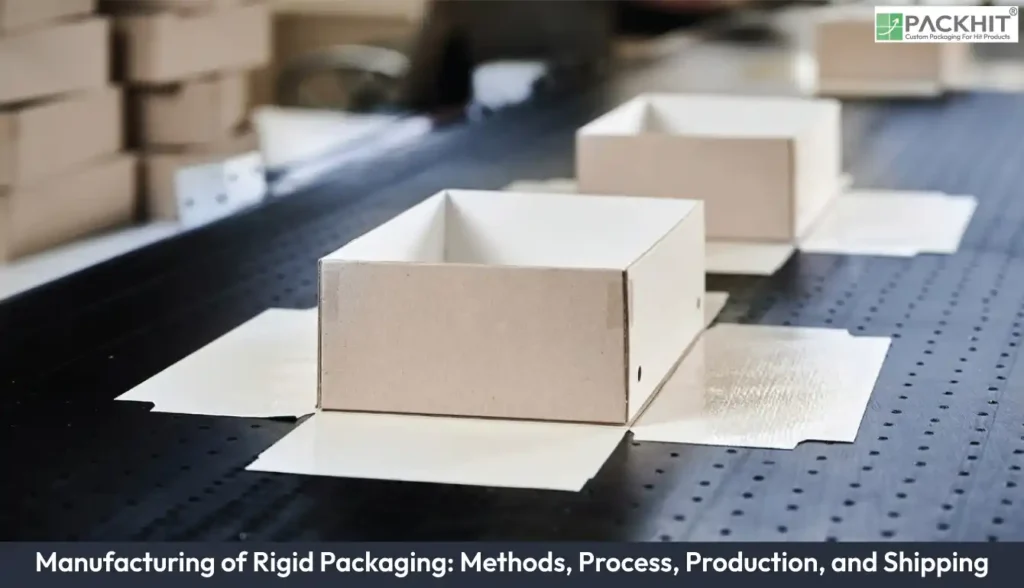
Rigid packaging manufacturing involves transforming durable materials into functional designs through advanced processes, including material selection, cutting, folding, printing, and laminating. Using methods like thermoforming, injection molding, and die-cutting, manufacturers ensure precision, scalability, and quality control. Key steps in rigid packaging production include material preparation, fabrication, surface treatments, and assembly, while logistical strategies like palletization optimize shipping. Challenges in rigid packaging manufacturing, such as material costs and environmental concerns, are addressed through recyclable and compostable options, process optimization, and adherence to evolving industry regulations.
- Which Methods are Used for Rigid Packaging Manufacturing?
- How is Rigid Packaging Manufactured?
- 1. Material Selection and Preparation
- 2. Sizing and Cutting
- 3. Folding and Gluing
- 4. Printing and Branding
- 5. Laminating and Surface Treatments
- 6. Quality Control and Inspection
- 7. Final Assembly and Packaging for Distribution
- What are the Key Steps in Rigid Packaging Production?
- How is Rigid Packaging Shipped and Distributed?
- What are the Challenges in Rigid Packaging Manufacturing?
- What is the Most Important Factor in Producing High-Quality Rigid Packaging?
Which Methods are Used for Rigid Packaging Manufacturing?
Rigid packaging manufacturing uses thermoforming, injection molding, die-cutting and folding, metal forming, and 3D printing for prototyping. Each method suits different materials and package forms: thermoforming shapes heated plastic sheets, injection molding forms molded plastic parts, die-cutting creates paperboard structures, and metal-forming processes shape cans and containers.
Thermoforming
Thermoforming is a manufacturing technique where plastic sheets, such as polyethylene terephthalate (PET) or polypropylene (PP), are heated until pliable and then shaped using a vacuum, pressure, or mechanical force. This method is widely used for producing clamshell packaging, trays, and inserts. Thermoforming ensures consistent wall thickness and dimensional accuracy, making it a preferred choice for high-volume production. The process is also energy-efficient and allows for the incorporation of recycled materials, aligning with sustainability goals.
Injection Molding
Injection molding is a manufacturing method in which molten plastic is injected into a mold cavity and allowed to cool and solidify into the required shape. Materials such as high-density polyethylene (HDPE), polypropylene (PP), and acrylonitrile butadiene styrene (ABS) may be used depending on the application.
The process is suitable for producing repeatable components with complex shapes and detailed features. Actual cycle times vary substantially according to factors such as the material, part size and thickness, mold design, cooling requirements, machine settings, and production equipment. For this reason, a single cycle-time range should not be treated as generally applicable to all rigid packaging products.
Die-Cutting and Folding
Die-cutting is a process primarily used for paperboard packaging. It involves cutting predefined shapes and patterns from sheets of paperboard, which are then folded and glued to form cartons, boxes, or sleeves. Advanced die-cutting machinery allows for high customization, including embossing, foil stamping, and the addition of transparent windows for product visibility. Surface treatments, such as UV coatings or laminations, can further enhance the packaging’s aesthetic appeal and durability. This method is particularly popular for retail packaging due to its cost-efficiency and design flexibility.
Metal Forming
Metal forming techniques, such as deep drawing, stamping, and roll forming, are employed to manufacture rigid metal packaging like cans, tins, and containers. Aluminum and tinplate are common materials due to their lightweight and excellent barrier properties against moisture, light, and air. These processes ensure uniform wall thickness and high structural integrity, making them suitable for applications requiring long-term product preservation, such as food packaging and industrial components. Secondary processes, like coating and sealing, are often applied to enhance corrosion resistance and ensure compliance with food safety standards.
3D Printing and Prototyping
An emerging method in rigid packaging manufacturing is 3D printing. While primarily used for prototyping, this process enables rapid production of highly customized packaging designs. Materials such as PLA (polylactic acid) and ABS are commonly used, offering the potential for biodegradable and recyclable options. Although not yet widely adopted for mass production, 3D printing is increasingly being used to create unique packaging solutions for premium products.
Method selection depends on the package material, geometry, wall or panel requirements, tooling, production volume, and intended application. For example, injection-molding settings affect part formation and cooling, while die-cutting accuracy influences how paperboard panels align during folding and assembly.
How is Rigid Packaging Manufactured?
Rigid packaging manufacturing involves a series of connected steps that transform raw materials into finished packaging. Depending on the design, machinery may control cutting dimensions, fold placement, adhesive application, print registration, surface finish, and final assembly.
1. Material Selection and Preparation
The foundation of rigid packaging manufacturing begins with the careful selection of durable materials like paperboard, chipboard, or corrugated cardboard. These materials are chosen for their strength, thickness, and structural integrity. Once selected, the materials undergo preparation, including cutting, shaping, and refining. High-precision machinery ensures consistency in dimensions, which is critical to maintaining uniformity across production batches. Rigid packaging relies on materials with sufficient structural strength and durability for the intended product and distribution environment. Common materials include:
- Paperboard: Paperboard is widely used for cartons, boxes, and rigid paper-based packaging. Available thicknesses vary by grade, construction, supplier, and intended application. Coatings or laminations may be added when additional moisture resistance, print performance, or surface durability is required.
- Plastics: Materials such as polyethylene (PE), polypropylene (PP), and polyethylene terephthalate (PET) are used in many rigid packaging applications because they can be formed into a wide range of shapes and performance characteristics. Suitability for a particular application depends on the resin grade, package design, manufacturing process, and applicable product requirements.
- Metals: Aluminum and tinplate are commonly used for cans and other rigid containers where strength and barrier performance are important.
- Glass: Glass is used for products that benefit from rigidity, chemical resistance, transparency, or a premium presentation, although its greater weight and breakability can affect handling and transportation requirements.
Material selection depends on factors such as product type, structural requirements, barrier performance, manufacturing method, cost, storage conditions, and applicable regulatory requirements.
2. Sizing and Cutting
Sizing involves processing raw materials into standardized dimensions based on the packaging’s design specifications. Cutting tools and high-precision machinery are used to create panels, flaps, and other structural components, ensuring a consistent fit during assembly. The accuracy of sizing is vital for maintaining the structural integrity and functionality of the final product.
3. Folding and Gluing
Pre-scored fold lines are created on the materials to facilitate easy and accurate folding. During assembly, panels are folded into their designated shapes, and adhesives are applied to secure the structure. For collapsible packaging, designs integrate foldable features that enhance storage and transportation efficiency. Automated folding and gluing machines ensure consistency, reducing manual errors and improving production speed.
4. Printing and Branding
Once the structural components are ready, printing and branding elevate the packaging’s aesthetic appeal. High-resolution offset printing is used to apply logos, patterns, and product information. Techniques such as embossing, metallic foiling, and debossing enhance the visual appeal and align the packaging with brand identity. These elements not only create a premium look but also ensure the packaging communicates the product’s value effectively.
5. Laminating and Surface Treatments
Lamination adds a protective layer to the material, enhancing durability and providing a polished finish. Additional treatments like UV coatings, spot varnishes, or matte finishes increase resistance to wear and elevate the rigid packaging’s aesthetic value. These enhancements ensure the rigid packaging remains visually appealing and functional under various conditions.
6. Quality Control and Inspection
Before distribution, packaging is checked for characteristics such as dimensions, structural condition, print quality, surface finish, and assembly. Inspection methods vary by material, package design, production volume, and intended use.
7. Final Assembly and Packaging for Distribution
In the final stage, the pre-assembled components are combined, if necessary, and prepared for shipping. Protective measures, such as shrink wraps or padded inserts, are applied to safeguard packaging during transit. The packaging is then palletized or nested to optimize space and minimize handling costs. This systematic approach can help protect packaging during handling and transit and support the delivery of functional products to customers.
The manufacturing of rigid packaging combines material science, automation, and design expertise to create solutions that meet the functional, aesthetic, and regulatory needs of various industries. By leveraging advancements in technology and adhering to strict quality standards, manufacturers can produce packaging that is not only durable but also visually appealing and sustainable.
Note: For paper-based rigid packaging, the primary manufacturing path uses materials such as paperboard, chipboard, or corrugated cardboard and processes such as cutting, folding, gluing, wrapping, printing, and finishing. Plastics, metals, glass, thermoforming, injection molding, metal forming, and 3D printing are broader rigid-packaging materials or methods and are relevant only when the package design or application calls for them.
What are the Key Steps in Rigid Packaging Production?
Rigid packaging production varies by material, package design, and manufacturing method. Paper-based rigid packaging may emphasize cutting, folding, gluing, wrapping, printing, and finishing, while plastic, metal, or glass formats use different forming and assembly processes. Automation may also be introduced at different stages for material handling, inspection, or assembly.
- Material Preparation: Raw materials are processed to meet specific requirements, such as thickness, purity, or moisture content.
- Fabrication: The chosen manufacturing method (e.g., injection molding, die-cutting) is applied to shape the material into the desired form.
- Surface Treatment: Coatings, laminations, or printing are added to enhance functionality and aesthetics.
- Quality Control: Products undergo rigorous testing for dimensional accuracy, strength, and compliance with industry standards.
- Assembly and Packaging: Components are assembled, if necessary, and packaged for shipping.
Automation plays a significant role in modern production lines, reducing labor costs and improving consistency. For example, robotic arms are often used for material handling and assembly tasks.
How is Rigid Packaging Shipped and Distributed?
The shipping and distribution of rigid packaging require a strategic approach to protect product integrity, control costs, and address applicable environmental and regulatory requirements. Specific requirements can vary substantially depending on the packaging material, product being packaged, destination, transportation method, and intended use.
- Packaging for Transport: Products are stacked, nested, or palletized to optimize space and reduce transportation costs. Protective materials, such as corrugated liners, foam inserts, air cushions, shrink wrap, or corner protectors, may be used to reduce damage during handling and transit.
- Storage and Handling: Storage conditions should be selected according to the characteristics of the packaging material and its intended application. Temperature, humidity, cleanliness, and handling practices may be especially important for packaging intended for food, pharmaceutical, or other sensitive products. Forklifts, conveyors, and automated guided vehicles (AGVs) are commonly used for efficient material handling.
- Logistical Coordination: Transportation methods are selected based on factors such as packaging weight, dimensions, destination, delivery schedule, and cost. International shipments may also be subject to customs, phytosanitary, pallet-treatment, documentation, and import requirements. For example, ISPM 15 may apply to certain wood packaging materials used in international trade, depending on the shipment and destination.
- Regulatory Compliance: Packaging requirements depend on the product, jurisdiction, materials, and intended use. Food-contact packaging, pharmaceutical packaging, labeling, hazardous-material packaging, and other regulated applications may be subject to different authorities and standards. Agencies and standards organizations such as the FDA, USDA, USP, or their equivalents in other jurisdictions may be relevant in particular circumstances, but these examples are not exhaustive.
- Sustainability Practices: Manufacturers may reduce environmental impact through recyclable or reusable materials, collapsible transport packaging, improved load configurations, reduced material use, and other logistics-efficiency measures. Applicable environmental or packaging-waste requirements can also differ by market.
A robust shipping strategy can improve product protection, logistics efficiency, and customer satisfaction. Because regulatory and compliance requirements change and differ across markets, manufacturers should verify the current requirements applicable to the specific product, packaging material, destination, and intended use with the relevant regulatory or customs authority or a qualified compliance professional before shipment or market release.
What are the Challenges in Rigid Packaging Manufacturing?
Despite its advantages, rigid packaging manufacturing faces several challenges, including:
- Material Costs: Raw-material costs can vary over time based on supplier pricing, availability, energy costs, transportation conditions, and market demand. Manufacturers should confirm current pricing and availability when preparing quotations, sourcing materials, and planning production.
- Environmental Concerns: The use of non-biodegradable materials raises sustainability concerns, encouraging greater use of recyclable, reusable, or lower-impact alternatives where technically and commercially appropriate.
- Design Complexity: Custom designs may require specialized tooling, equipment, testing, or longer production cycles, which can increase cost and lead time.
- Regulatory Compliance: Packaging used for food, pharmaceuticals, hazardous materials, or other regulated applications may be subject to product- and jurisdiction-specific safety, labeling, material, testing, and documentation requirements. Because these requirements can change, manufacturers should verify the current rules applicable to the product, material, destination, and intended use before production or market release.
Addressing these challenges requires ongoing attention to material selection, process efficiency, design requirements, supply conditions, and applicable regulations.
What is the Most Important Factor in Producing High-Quality Rigid Packaging?
The key is to maintain precision and consistency throughout the manufacturing process, from material selection and cutting to printing, assembly, quality control, and shipping. Careful material choices, automated production, and rigorous inspections help ensure the packaging is durable, visually appealing, cost-efficient, and suitable for protecting the product throughout its lifecycle.