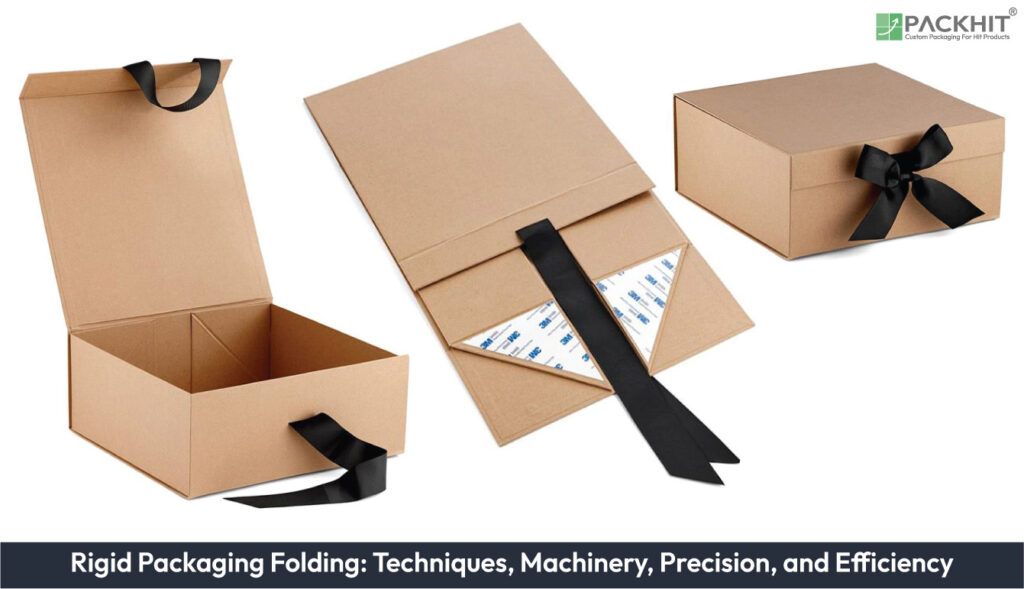
Rigid packaging folding transforms materials such as paperboard and composite laminates through techniques including creasing, scoring, die-cutting, and heat folding. The process can involve machinery such as folding carton gluers, rotary die-cutters, and automated systems, with results influenced by factors including material properties, machine calibration, tooling, and environmental conditions. Automation, workflow planning, material optimization, and batch processing may also support production efficiency depending on the equipment and process setup.
Rigid packaging folding is used across consumer, food, luxury, and industrial applications. Its suitability relative to flexible packaging depends on the product, required protection, package design, material choice, cost, and branding objectives.
- What is Rigid Packaging Folding?
- Core Techniques in Rigid Packaging Folding
- Machinery Used for Rigid Packaging Folding
- What Factors Influence Precision in Rigid Packaging Folding?
- How is Efficiency Achieved in Rigid Packaging Folding?
- Applications of Rigid Packaging Folding
- How Should Manufacturers Choose a Rigid Packaging Folding Method?
- Rigid Packaging Folding Compared to Flexible Packaging
What is Rigid Packaging Folding?
Rigid packaging folding is a manufacturing process used to transform relatively stiff substrates, such as paperboard, corrugated fiberboard, and some composite laminates, into defined packaging structures. The process involves controlled cutting, creasing, scoring, folding, and, where applicable, bonding or heat-assisted forming to create packaging with the required shape and dimensions.
Compared with flexible packaging, rigid or semi-rigid folded formats generally rely on stiffer materials and predefined structural forms. Their performance depends on factors such as substrate properties, package design, fold geometry, manufacturing setup, and intended use.
The process can incorporate techniques such as creasing, scoring, die-cutting, and heat folding, with each method selected according to the material and package design. These methods are intended to help manufacturers achieve specified dimensional, structural, and presentation requirements while supporting product and branding objectives.
Core Techniques in Rigid Packaging Folding
Rigid packaging folding can use several techniques to manipulate materials such as paperboard, corrugated fiberboard, and composite laminates into predefined shapes and structures. Common methods include:
- Creasing: Creasing creates a controlled indentation along a planned fold line to help the material bend more predictably. It can reduce the likelihood of cracking or uncontrolled deformation, depending on the substrate, crease geometry, and machine settings.
- Scoring: Scoring weakens or partially cuts the material along a designated line to facilitate folding. It can be useful for thicker or more resistant substrates where a defined fold line is required.
- Die-Cutting: Die-cutting uses shaped tooling to cut blanks, openings, and other package features. Creasing rules may also be incorporated into the die so that cutting and fold preparation can be carried out during the same operation.
- Heat Folding: Heat folding applies localized heat to suitable thermoplastic materials, coatings, or laminates to make bending easier. The material may retain the formed shape after cooling, depending on its composition and processing conditions.
The appropriate technique depends on factors such as material type, thickness, fold geometry, package design, production volume, and required finish.
Machinery Used for Rigid Packaging Folding
Equipment used in rigid packaging folding can include folding carton gluers, rotary die-cutters, creasing and scoring machines, and automated folding systems. The suitability and performance of each machine depend on the packaging format, substrate, tooling, setup, and production requirements.
Folding Carton Gluers
Folding carton gluers combine operations such as folding, adhesive application, and compression to convert pre-cut blanks into finished cartons or carton components. When properly configured and maintained, these machines can support repeatable folding and dimensional results in higher-volume production.
Rotary Die-Cutters
Rotary die-cutters use rotating tooling to cut, crease, perforate, or otherwise convert packaging material as it moves through the machine. They can support continuous production and may be suitable for packaging designs that require multiple converting operations in a single pass. Accuracy depends on factors such as tooling condition, registration, material behavior, and machine setup.
Creasing and Scoring Machines
Dedicated creasing and scoring equipment applies controlled pressure or cutting action along intended fold lines. Properly selected tooling and machine settings can help produce more consistent folds while limiting unwanted deformation or cracking.
Automated Folding Systems
Automated folding systems may use programmable controls, servo-driven components, robotic handling, or other automation technologies to perform defined folding sequences with reduced manual intervention. Depending on the equipment, application, and setup, automation may improve repeatability, production consistency, and throughput.
Some modern systems also incorporate sensors, servo motors, and computer-aided controls to monitor or adjust production parameters. These features can help improve process consistency and may reduce material waste or production variation when appropriately configured and maintained.
What Factors Influence Precision in Rigid Packaging Folding?
Precision in rigid packaging folding depends on several interrelated factors.
Material Properties
Substrate stiffness, thickness, grain direction, coating, and surface characteristics can affect fold behavior and the likelihood of cracking, warping, or deformation. Stiffer or thicker materials may require adjusted crease geometry, tooling, or processing conditions to produce the intended fold.
Tooling Accuracy
The alignment, dimensions, condition, and sharpness of creasing, scoring, and cutting tools can influence fold position and dimensional consistency. Appropriate tooling can help reduce issues such as uneven edges, inaccurate crease placement, and inconsistent fold angles.
Machine Calibration
Machine settings such as pressure, alignment, speed, and registration can affect folding consistency. Routine calibration and maintenance may help reduce problems such as misalignment, material deformation, and variation between production runs.
Environmental Conditions
Temperature and humidity can influence the behavior of paper-based and other moisture-sensitive substrates. Changes in environmental conditions may affect stiffness, moisture content, dimensional stability, or susceptibility to cracking and warping. Production environments may therefore be controlled where material sensitivity or process requirements make this necessary.
Manufacturers may use material testing, trial runs, and prototype folding to determine suitable process settings before full-scale production.
How is Efficiency Achieved in Rigid Packaging Folding?
Efficiency in rigid packaging folding can be improved through automation, workflow planning, material utilization, and production scheduling. The effectiveness of these approaches depends on the equipment, package design, production volume, and operating conditions.
- Automated Systems: Automation can reduce manual handling and support repeatable production steps. Depending on the application and system configuration, it may also improve throughput and reduce some sources of operator variation.
- Lean Manufacturing Practices: Workflow analysis and lean manufacturing methods can help identify unnecessary movement, delays, setup activities, or production bottlenecks. Their effectiveness depends on how they are implemented within a particular operation.
- Material Optimization: Layout planning and controlled cutting can help improve substrate utilization and reduce offcuts. Software-based nesting or layout tools may also assist manufacturers in planning more efficient material use.
- Batch Processing: Grouping similar packaging designs or production runs can reduce the frequency of machine changeovers and setup adjustments. This approach may improve workflow efficiency when production schedules and order requirements allow.
By combining suitable equipment, process controls, material planning, and production practices, manufacturers can work toward higher output while maintaining the quality requirements specified for a particular packaging application.
Applications of Rigid Packaging Folding
Rigid packaging folding is used across a range of industries for packaging that requires defined shapes, structural support, and presentation features. Common applications include:
- Consumer Goods Packaging: Folding techniques are used to produce boxes and cartons for electronics, cosmetics, and household items.
- Food and Beverage Packaging: Folded paperboard and similar formats are used for products such as frozen foods, beverages, and other packaged goods where structural support is needed.
- Luxury Packaging: Folding methods are used in premium packaging for products such as jewelry, cosmetics, and fashion items, where presentation and finish are important considerations.
- Industrial Packaging: Folded rigid or semi-rigid formats may be used for automotive parts, machinery components, and other products requiring more structured packaging.
How Should Manufacturers Choose a Rigid Packaging Folding Method?
The choice of folding method and equipment depends on the relationship between the substrate, package design, production requirements, and desired finish.
- Material type and thickness: Stiffer or thicker substrates may require more controlled creasing or scoring to form the intended fold without excessive cracking or deformation.
- Fold geometry: Simple folds may be handled with standard creasing and folding equipment, while more complex shapes may require die-cutting or multiple converting steps.
- Production volume: Higher-volume production may justify automated folding systems or integrated machinery that combines several operations, while lower-volume or prototype work may rely on simpler setups.
- Required finish: Packaging with tighter visual or dimensional requirements may need more careful tooling, calibration, and process control.
- Package application: The level of structural support, presentation, and material performance required for the product can influence both the substrate and folding approach.
For example, a thicker paperboard carton with several defined fold lines and a presentation-focused finish may require controlled creasing, accurate die-cutting, and careful machine setup. A simpler carton made from a lighter substrate may be compatible with a less complex folding process.
This framework helps connect material and design requirements to the choice of folding technique and machinery rather than treating each method as universally suitable.
Rigid Packaging Folding Compared to Flexible Packaging
Rigid packaging folding differs from flexible packaging in material composition, structural characteristics, production methods, and typical applications. Key distinctions include:
- Material Composition: Rigid packaging generally uses thicker, stiffer substrates, while flexible packaging commonly uses lightweight films and laminates.
- Structural Characteristics: Rigid packaging may provide greater resistance to some mechanical stresses, while flexible packaging can adapt more easily to irregular shapes and changing product forms.
- Production Complexity: Rigid packaging folding may require specialized machinery and forming techniques, while flexible packaging often uses different converting and sealing processes depending on the material and package design.
- End-Use Applications: Rigid and flexible packaging can serve a wide range of products, with suitability depending on factors such as product sensitivity, required protection, weight, format, storage, and presentation needs.
The appropriate packaging format depends on the product, package design, material choice, protection requirements, cost considerations, and branding objectives.
