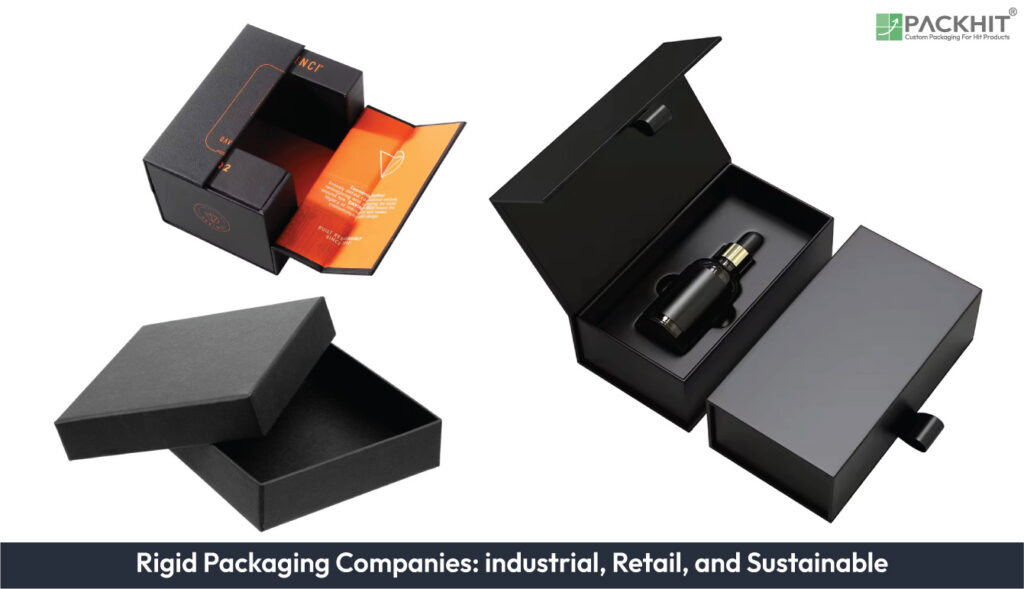
The rigid packaging industry is segmented by specialized focus, differentiating between industrial providers that prioritize compliance and heavy-duty durability, retail firms that emphasize aesthetic functionality and shelf appeal, and sustainable specialists dedicated to circular economy materials and environmental impact reduction.
Industrial packaging leaders, such as Greif, Inc. and Mauser Packaging Solutions, deliver durable and compliant materials, including steel drums, fiber drums, and intermediate bulk containers (IBCs), tailored for sectors like chemicals and heavy manufacturing.
Retail packaging firms, including Amcor, Sonoco, Placon, and Silgan Holdings, prioritize aesthetics and functionality. They offer innovative designs ranging from lightweight PET containers and rigid paperboard cans to thermoformed food and healthcare packaging, as well as vacuum-sealed consumer goods containers, effectively balancing practicality with retail shelf appeal.
Sustainable packaging specialists, such as Berry Global, DS Smith, ALPLA, and Pactiv Evergreen, focus on eco-friendly innovations. These companies leverage recycled plastics, renewable paper-based fibers, and circular business models to minimize environmental impact while meeting the evolving needs of manufacturers and consumers.
Below is a list of leading companies and their areas of expertise:
- Greif, Inc.
- Mauser Packaging Solutions
- Amcor
- Sonoco
- Placon
- Silgan Holdings
- Berry Global
- DS Smith
- ALPLA
- Pactiv Evergreen
- How Do Retail Rigid Packaging Companies Balance Functionality and Aesthetics?
- Which Companies Lead in Rigid Packaging Innovation?
- How Do Rigid Packaging Companies Address Customization Needs?
- How Do Rigid Packaging Companies Adapt to Market Trends?
- How to Evaluate Rigid Packaging Companies?
Greif, Inc.
Greif, Inc. specializes in producing high-performance steel drums and intermediate bulk containers (IBCs) tailored to the needs of the chemical and pharmaceutical sectors. These solutions are designed to prioritize durability, leak prevention, and adherence to international safety standards, ensuring the secure handling and transport of sensitive materials.
Mauser Packaging Solutions
Mauser Packaging Solutions offers a diverse range of industrial rigid packaging, including plastic drums, fiber drums, and IBCs. The company emphasizes scalability for high-volume operations, regulatory compliance, and compatibility with varying industrial requirements.
Amcor
Amcor produces lightweight PET containers that incorporate advanced molding and printing technologies. These containers feature tamper-evident seals and ergonomic designs, making them highly suitable for packaging in the food, beverage, and personal care sectors. By focusing on innovation, Amcor ensures that its packaging solutions address both functionality and aesthetic appeal, catering to modern retail demands.
Sonoco
Sonoco develops rigid paperboard cans that emphasize sustainability through recyclability and customization. These packaging solutions are widely adopted in the food and personal care industries, offering structural durability alongside eco-friendly alternatives to traditional metal or plastic containers. Their designs align with both industry needs and environmental considerations.
Placon
Placon specializes in thermoformed rigid packaging, particularly for food and healthcare retail applications. By integrating post-consumer recycled content into its packaging designs, Placon ensures product protection while prioritizing environmental sustainability. Their solutions exemplify the balance between innovation and eco-conscious manufacturing.
Silgan Holdings
Silgan Holdings provides a range of innovative metal and plastic rigid packaging solutions tailored for consumer goods. Their portfolio includes resealable lids and vacuum-sealed containers designed to extend product freshness while maintaining a visually appealing presence on retail shelves. These designs effectively combine practicality with shelf appeal.
Berry Global
Berry Global incorporates recycled plastics in some product lines, with the percentage varying by product. The company employs closed-loop systems to recycle post-consumer materials into new packaging, significantly reducing waste and environmental impact.
DS Smith
DS Smith specializes in paper-based rigid packaging made from recyclable and biodegradable materials. Their circular business model ensures that packaging can be reused, recycled, or composted, catering to industries such as e-commerce and retail with eco-friendly alternatives.
ALPLA
ALPLA develops sustainable rigid plastic packaging using recycling technologies. The company produces packaging with high percentages of post-consumer recycled content and is actively working toward carbon-neutral production processes.
Pactiv Evergreen
Pactiv Evergreen focuses on molded fiber and paper-based rigid packaging tailored for food and beverage applications. Their solutions emphasize renewable sourcing and compostability, offering designs that align with the sustainability objectives of industries they serve.
The companies above are grouped by packaging type and commonly described capabilities. Remember to verify current materials, certifications, performance data, and packaging fit directly with each provider.
How Do Retail Rigid Packaging Companies Balance Functionality and Aesthetics?
Retail rigid packaging companies maintain a delicate balance between structural integrity and visual appeal to satisfy both supply chain requirements and consumer expectations. For instance, Amcor produces lightweight PET containers using advanced molding and printing technologies, featuring ergonomic designs and tamper-evident seals that cater to the food, beverage, and personal care sectors.
Similarly, Sonoco focuses on recyclable and customizable paperboard cans, providing a durable yet eco-friendly alternative to traditional materials. Placon specializes in thermoformed packaging for food and healthcare retail, integrating post-consumer recycled content without compromising product protection. To further enhance shelf appeal and practicality, Silgan Holdings offers innovative solutions like resealable lids and vacuum-sealed containers for consumer goods, designed to extend freshness while maintaining a high-end retail presence.
Which Companies Lead in Rigid Packaging Innovation?
Rigid packaging companies like Sealed Air Corporation and Crown Holdings stand out for their technological advancements. Sealed Air’s Cryovac® rigid packaging solutions incorporate barrier technologies to extend product shelf life, particularly in the food industry. Crown Holdings, a leader in metal packaging, has developed lightweight aluminum cans with enhanced recyclability, catering to the beverage sector.
These rigid packaging companies also leverage digital tools such as predictive analytics to forecast packaging demand and throughput, and IoT-enabled tracking for real-time shipment visibility (monitoring location and condition) to optimize supply chain efficiency. For instance, Sealed Air utilizes this IoT tracking to monitor cold chain temperature integrity, while Crown Holdings applies specialized coatings to its metal packaging to ensure extended shelf life. By integrating these technologies, they not only improve operational performance but also enhance customer satisfaction through real-time monitoring and traceability.
How Do Rigid Packaging Companies Address Customization Needs?
Rigid packaging companies address customization needs by tailoring structural design and branding to client specs, then validating manufacturing precision with prototyping, e.g., WestRock’s rigid paperboard for luxury and electronics and Huhtamaki’s molded fiber for foodservice.
- Digital design workflows: Utilizing 3D printing and digital prototyping to accelerate development cycles.
- Specialized material selection: Choosing specific substrates like rigid paperboard or molded fiber to meet aesthetic and sustainability goals.
- Regulatory validation: Ensuring that packaging meets strict standards, particularly for pharmaceutical and food-safety applications.
How Do Rigid Packaging Companies Adapt to Market Trends?
Market trends such as e-commerce growth, urbanization, and changing consumer preferences are profoundly reshaping the rigid packaging industry, compelling companies to pivot toward specialized, high-performance solutions.
The rise of e-commerce has necessitated packaging that prioritizes product integrity during transit; manufacturers like Pratt Industries are responding with corrugated solutions engineered for superior shock and drop resistance, while others integrate IoT tracking to monitor conditions in real time. Simultaneously, rapid urbanization has driven demand for convenience, leading to the proliferation of single-serve, portion-controlled formats. Leading firms are addressing this shift by designing compact, resealable containers that maintain freshness, a focus echoed by companies such as Silgan Holdings with their vacuum-sealed, shelf-appealing designs.
Furthermore, as sustainability becomes a non-negotiable expectation, industry leaders like Berry Global, DS Smith, and ALPLA are increasingly incorporating post-consumer recycled content and renewable materials into their rigid structures, effectively balancing the modern requirements for durability, aesthetic appeal, and environmental responsibility
How to Evaluate Rigid Packaging Companies?
Selecting the right rigid packaging partner requires assessing several key performance and operational criteria.
- Compliance and Regulatory Standards: Ensure the provider adheres to international safety standards (e.g., for chemicals or food contact) and provides documented evidence of compliance.
- Barrier and Containment Performance: Assess the packaging’s ability to protect the product, such as its drop and shock resistance, moisture barrier properties, or leak prevention capabilities.
- Sustainability Data: Evaluate the use of recycled materials (e.g., post-consumer recycled content targets) and recyclability certifications.
- Validation and Prototyping: Look for companies that offer robust prototyping and qualification services to test the packaging under real-world conditions before full-scale production.