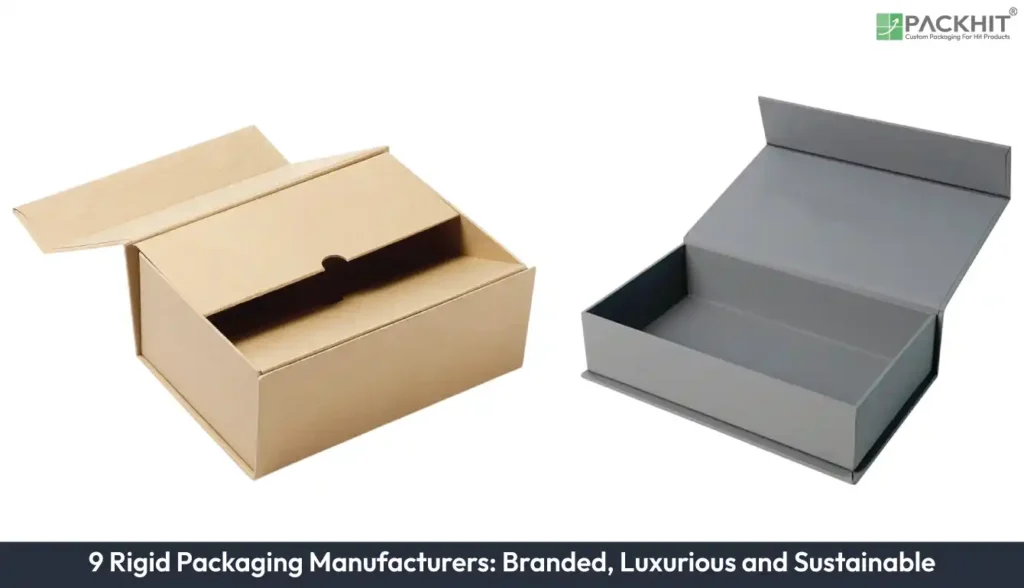
Rigid packaging manufacturers are essential partners for brands across the food, beverage, healthcare, and personal care sectors, providing solutions that balance aesthetics with functionality. Industry leaders, including Packhit, WestRock, Amcor, DS Smith, Smurfit Kappa, Crown Holdings, Mondi Group, Berry Global, and Sonoco, utilize advanced manufacturing techniques to deliver branded, sustainable, and high-performance packaging.
Rigid packaging manufacturers’ offerings include paperboard, molded fiber, plastic, and metal-based packaging, each designed to balance functionality, aesthetics, and environmental responsibility. These manufacturers enable brands to customize packaging with logos, color schemes, and structural innovations like magnetic closures or hidden compartments, all while ensuring compliance with luxury and eco-conscious market demands. Leveraging cutting-edge technologies like NFC tags, augmented reality, and anti-counterfeiting measures, rigid packaging manufacturers enhance consumer engagement and brand value. By focusing on sustainability, branding, and consumer experience, rigid packaging manufacturers cater to the growing demand for eco-friendly, visually compelling, and durable packaging solutions that elevate product appeal and align with modern market expectations.
The following nine manufacturers are recognized for their expertise in producing branded, luxurious, and sustainable rigid packaging solutions:
- 1. Packhit
- 2. WestRock
- 3. Amcor
- 4. DS Smith
- 5. Smurfit Kappa
- 6. Crown Holdings
- 7. Mondi Group
- 8. Berry Global
- 9. Sonoco
- How Do Rigid Packaging Manufacturers Incorporate Branding?
- What Makes Rigid Packaging Manufacturers a Key Player in Luxury Packaging?
- How Do Rigid Packaging Manufacturers Address Sustainability?
- How to Choose the Right Rigid Packaging?
1. Packhit
Packhit specializes in creating fully customizable rigid packaging solutions tailored to meet diverse industry needs. It offers premium paperboard boxes, magnetic closure designs, and structural innovations that enhance both functionality and visual appeal. Packhit allows businesses to personalize every aspect of their packaging, from logo placement and color schemes to intricate finishes such as embossing, foil stamping, and spot UV. By integrating cutting-edge digital printing technology, Packhit delivers precise and high-quality results, ensuring that the rigid packaging reflects the brand’s identity and message.
2. WestRock
WestRock excels in designing and manufacturing paperboard-based rigid packaging solutions tailored to industries such as food, beverage, and healthcare. Its range includes innovative, customizable designs that meet both functional and aesthetic requirements. WestRock emphasizes sustainability through the use of recycled and responsibly sourced materials, alongside initiatives to reduce carbon emissions across its global production facilities. The company’s advanced packaging systems not only enhance product presentation but also align with modern environmental standards, making it a preferred choice for eco-conscious brands.
3. Amcor
Amcor is a global powerhouse in rigid plastic packaging, offering lightweight and durable solutions for sectors including pharmaceuticals, personal care, and food products. The company’s design innovations focus on reducing material usage while maintaining product integrity, which is vital for industries requiring high safety and hygiene standards. Amcor’s leadership in sustainability is evident in its development of recyclable and reusable packaging, underpinned by cutting-edge material science to lower the environmental impact of its products.
4. DS Smith
DS Smith leads in fiber-based rigid packaging, utilizing corrugated and molded pulp materials to create visually striking and sustainable designs. Its solutions cater predominantly to the e-commerce and retail sectors, where durability and strong branding elements are critical. Committed to the circular economy, DS Smith integrates recycled content into their packaging and works to eliminate waste across the supply chain, positioning itself as an innovator in sustainable packaging practices.
5. Smurfit Kappa
Smurfit Kappa is a prominent name in paper-based rigid packaging, known for delivering innovative, market-specific designs. Smurfit Kappa’s Eco-Tainer® range highlights its dedication to environmental stewardship, offering biodegradable and recyclable packaging options that address the growing demand for sustainable solutions. Smurfit Kappa’s packaging is widely adopted in the food and beverage industry, where safety, sustainability, and brand appeal converge to meet consumer expectations.
6. Crown Holdings
Crown Holdings specializes in rigid metal packaging, particularly aluminum and steel containers designed for the food and beverage industries. Its lightweight yet robust containers are engineered for product safety and extended shelf life, and may contribute to reduced material consumption, depending on the packaging format. Crown Holdings also invests in sustainability through initiatives like increasing the recyclability of its metal packaging, which often achieves high recycling rates among packaging materials, depending on local recovery infrastructure.
7. Mondi Group
Mondi Group stands out with its hybrid rigid packaging solutions, combining paper and plastic to meet diverse industry needs. The focus on innovation is evident in its development of renewable, resource-efficient materials and designs. Mondi’s sustainability strategy encompasses the entire lifecycle of its products, from sourcing renewable resources to implementing energy-efficient manufacturing processes. Mondi Group’s packaging serves industries such as food, personal care, and industrial applications, balancing performance with environmental responsibility.
8. Berry Global
Berry Global is a prominent leader in rigid plastic packaging, delivering versatile solutions across healthcare, personal care, food, and industrial sectors. Its product portfolio extends from tamper-evident containers for pharmaceuticals to durable packaging for industrial chemicals. Sustainability is integral to its operations, demonstrated through the incorporation of post-consumer recycled (PCR) materials and investments in advanced closed-loop recycling systems. Berry Global’s innovation includes lightweight designs that reduce material usage while maintaining structural integrity, which is critical for reducing environmental impact. The company’s commitment to circular economy principles positions it as a trusted partner for manufacturers seeking eco-friendly packaging alternatives.
9. Sonoco
Sonoco is a diversified leader in rigid packaging, offering a wide range of solutions including composite cans, rigid paperboard containers, and injection-molded plastic packaging. Its innovations cater to industries such as food, beverage, healthcare, and consumer goods. A hallmark of Sonoco’s approach is its focus on sustainability, highlighted by its “EnviroSense” initiative, which emphasizes the development of packaging designed for recyclability and compostability. Sonoco utilizes renewable materials and advocates for closed-loop recycling systems, ensuring minimal environmental impact. With a strong emphasis on performance, branding, and eco-friendliness, Sonoco is often considered a key player in addressing the complex needs of modern packaging.
How Do Rigid Packaging Manufacturers Incorporate Branding?
Branding in rigid packaging is achieved through customization and design innovation. Manufacturers work closely with businesses to incorporate logos, color schemes, and unique patterns that align with the brand’s identity. Advanced printing technologies, such as digital printing and offset lithography, enable precise reproduction of brand elements. Rigid packaging is tailored to convey specific brand messages, such as sustainability or luxury, ensuring that the product resonates with target consumers. This level of personalization helps brands stand out in competitive markets while maintaining a consistent brand image.
What Makes Rigid Packaging Manufacturers a Key Player in Luxury Packaging?
Rigid packaging manufacturers play a critical role in luxury packaging by combining premium materials, innovative designs, and advanced manufacturing techniques to create products that enhance brand perception and consumer experience. Here are the key factors that establish their significance:
- Premium Material Selection: Luxury packaging relies on high-quality materials such as rigid paperboard, molded fiber, and hybrid composites. These materials offer durability, a superior tactile feel, and the visual appeal required to communicate exclusivity and elegance. Manufacturers source these materials responsibly to align with sustainability goals while maintaining their premium quality.
- Advanced Customization Capabilities: Rigid packaging manufacturers provide extensive customization options, including intricate embossing, foil stamping, and high-definition printing. These techniques allow brands to incorporate unique design elements, such as logos, patterns, and color palettes, that represent their identity and appeal to luxury consumers.
- Innovative Structural Designs: Luxury packaging often features creative structural designs, such as magnetic closures, hidden compartments, and multi-layered boxes, to deliver a memorable unboxing experience. These designs can enhance functionality and often create a sense of exclusivity and sophistication, depending on the materials and structural choices used.
- Integration of Sustainability: Consumers increasingly demand eco-friendly luxury packaging. Manufacturers address this by integrating recyclable, biodegradable, and renewable materials into their designs without compromising aesthetics. This approach allows luxury brands to meet environmental standards while maintaining their high-end appeal.
- Use of Cutting-Edge Technology: Technologies such as augmented reality (AR), NFC (Near Field Communication) tags, and anti-counterfeiting measures are increasingly incorporated into luxury rigid packaging. For rigid packaging, AR/NFC is most useful when the brand needs post-purchase engagement (e.g., authenticity confirmation or product storytelling) and when the production process supports durable tag placement without affecting closure performance.
- Focus on Consumer Experience: Luxury packaging is designed to evoke emotional responses and create a lasting impression. Manufacturers achieve this by focusing on sensory elements such as texture, weight, and opening mechanisms, which contribute to a heightened consumer experience.
- Strong Brand Partnership: Rigid packaging manufacturers collaborate closely with brands to develop packaging that aligns with their marketing strategies and target audience. This partnership ensures that the final product not only protects the contents but also enhances the brand’s narrative and market positioning.
In practice, brands usually need to balance material premium and sustainability goals. Strong visual cues like embossing or foil can elevate perceived luxury, but choosing recyclability-focused materials (and matching them with suitable structural designs) helps avoid sacrificing eco messaging.
How Do Rigid Packaging Manufacturers Address Sustainability?
Sustainability is a core focus for rigid packaging manufacturers, driven by escalating consumer demand and regulatory pressures. To minimize environmental impact, these companies continuously develop biodegradable, compostable, and recyclable materials while implementing closed-loop systems to recycle waste back into production. They lower carbon emissions by adopting energy-efficient technologies, such as integrating heat recovery into molding or curing lines to reduce boiler fuel consumption where plant layouts permit. Furthermore, manufacturers demonstrate accountability by pursuing certifications like FSC® for responsible fiber sourcing and ISO 14001 for environmental management. Many leading firms actively engage consumers by offering return incentives, which successfully boosts material recovery rates when supported by robust reverse logistics infrastructure.
Note: Manufacturers must balance the ambition of these sustainability strategies with operational and economic reality. While large-scale initiatives like closed-loop recycling and energy-intensive heat recovery offer significant long-term environmental benefits, they require high production volumes to be cost-effective. For many projects, the most practical sustainability gains come from prioritizing ‘design for recycling’, choosing monomaterial compositions and simpler structures early in the development process, which can inherently reduce waste without requiring complex infrastructure.
How to Choose the Right Rigid Packaging?
To select the right rigid packaging, navigate the delicate balance between brand aesthetics, functional performance, and sustainable production. The following criteria serve as a framework to help brands evaluate their packaging strategy, ensuring that material choices, finish details, and structural design align with both consumer expectations and long-term operational goals.
- Material Compatibility: Assess the product’s weight and fragility against the material’s structural integrity. For luxury goods, prioritize high-quality paperboard or rigid plastics that maintain shape, whereas consumer goods might favor lightweight composites.
- Finish and Texture Trade-offs: Balancing aesthetic appeal with durability is key. For example, while foil stamping and embossing add premium tactile appeal, they may complicate the recycling process if not integrated correctly with the base material.
- Structural Complexity vs. Production Cost: Determine if unique designs like magnetic closures or hidden compartments are essential for the brand experience. Complex structures often increase production time and cost, requiring a clear ROI in brand differentiation.
- Sustainability Alignment: Evaluate certifications (like FSC® or ISO 14001) relative to the specific product supply chain goals. Ensure the chosen materials can be effectively recovered in the end-market’s recycling infrastructure.
Scalability and Lead Times: Consider if the chosen customization and design complexity can be maintained at scale. Highly customized packaging with unique finishes may require longer lead times compared to standard, modular designs.
