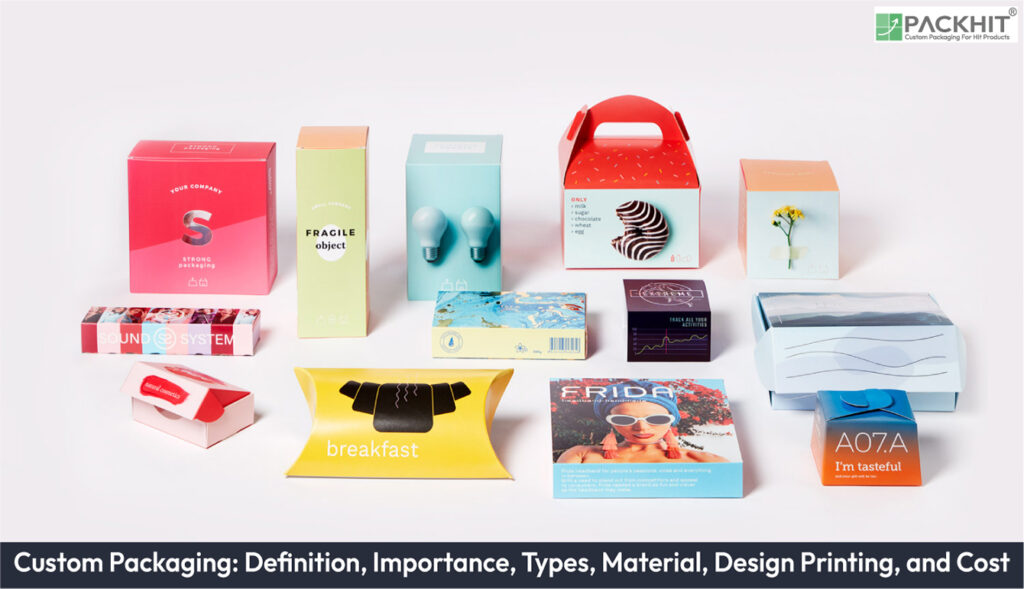
Custom packaging is tailor-made packaging designed to meet specific branding, functionality, and product protection needs, offering a distinct advantage over generic stock packaging. Unlike pre-made options, custom packaging incorporates unique dimensions, materials, colors, logos, and finishes to reflect a brand’s identity, enhance product appeal, and deliver memorable customer experiences. Custom packaging comes in various types, such as boxes, pouches, tubes, and wraps, and can be crafted from eco-friendly or premium materials like cardboard, kraft paper, corrugated fiberboard, or rigid, depending on the product and sustainability goals.
Custom packaging uses design elements like logos, typography, imagery, and shapes in combination with advanced printing techniques (digital, offset, flexographic) and finishing options (embossing, foil stamping, UV coating) to create visually striking and highly functional packaging.
- What is Custom Packaging?
- How does Custom Packaging Impact the Branding of a Product?
- Why is Custom Packaging Important for Brands?
- Types of Custom Packaging
- Materials Used for Custom Packaging
- Which Design Elements are Used for Custom Packaging?
- Printing Methods for Custom Packaging
- How to Make Custom Packaging?
- How Much Does Custom Packaging Cost?
- Is It Worth Investing in Custom Packaging?
- What are the Most Affordable Custom Packaging Options for Small Businesses?
- Benefits of Custom Packaging
- Custom Packaging Ideas for Brands
- Which Packaging Companies Provide Reliable Custom Packaging for Brands?
What is Custom Packaging?
Custom packaging is a type of packaging that is produced in the desired design, shape, material, and style to safely pack, store, and ship any tangible product, for example, food, cosmetics, and candles, while promoting the brand.
Custom packaging designs are produced based on specific dimensions, branding elements, and material preferences, making it unique to a brand. In contrast, stock packaging is standard, generic, and mass-produced in fixed sizes, shapes, and materials without customization options. Unlike custom packaging, standard (pre-made) packaging does not allow businesses to personalize their packaging with logos, colors, or unique design elements, limiting branding opportunities.
Custom Packaging vs Stock Packaging
Custom packaging is created for a specific product using tailored dimensions, materials, structural features, branding elements, and protection requirements. Stock packaging, by contrast, is mass-produced in standard sizes and styles that can accommodate a variety of products.
Understanding the differences between custom and stock packaging helps businesses compare their design flexibility, cost, availability, branding potential, and product-protection capabilities. Custom packaging offers tailored sizes and structural features that can reduce transit damage, which helps preserve product fit and keeps the branding legible during handling. Stock packaging is readily available and generally more cost-effective, making it suitable for standard shipping, storage, and budget-conscious applications.
How does Custom Packaging Impact the Branding of a Product?
Custom printed packaging impacts the branding of a product by enhancing brand recognition, reinforcing brand identity, creating a memorable first impression, and differentiating it from competitors. It helps businesses stand out by incorporatingunique colors, logos, and designs that make the brand and product easily recognizable. Custom packaging is a tangible representation of a brand’s values, whether through sustainable materials or premium finishes that signal quality. For example, durable coatings (lamination/UV coating) help maintain appearance during handling, so the printed logo and color stay crisp through shipping.
Why is Custom Packaging Important for Brands?
It is important for brands because it can enhance brand identity and help protect products during transit. Many brands also choose eye-catching visuals and premium finishes to help attract attention on store shelves and online. This matters most when the package is handled frequently or displayed in high-traffic retail, because finishes that resist scuffs and fading keep the branding legible.
Types of Custom Packaging
Custom packaging comes in various types, such as boxes, bags, pouches, tubes, sleeves, trays, and wraps, to suit different products, branding, and shipping needs.
- Boxes: Boxes are used to protect products during storage and shipping while also serving as a medium for branding and product presentation. Custom boxes are commonly used for e-commerce deliveries, electronics, retail goods, subscription services, and luxury items.
- Bags: Bags are lightweight and portable, making them ideal for customers to carry products conveniently while showcasing brand identity. Custom bags are frequently used in retail stores, food takeout services, promotional events, and gift packaging.
- Pouches: Pouches offer a compact, flexible, and often resealable packaging option that helps preserve product freshness and enhance shelf appeal. Custom pouches are widely used for food items, health supplements, cosmetics, and pet treats.
- Tubes: Tubes provide a sleek and protective packaging option, especially suitable for cylindrical or rolled items. These tubes are often used for posters, artwork, cosmetics like creams and balms, and specialty food products.
- Sleeves: Sleeves are designed to slide over existing products or containers to add a layer of branding and visual appeal without much added cost. Custom sleeves are typically used for items such as soaps, candles, bakery goods, and books.
- Trays: Trays help organize and securely hold products in place while also offering a neat and presentable layout. They are commonly used in food service for baked goods, in electronics for component display, and in packaging sets or kits.
- Wraps: Wraps provide a protective layer while adding a decorative or branded touch to the product. They are often used for fragile items, gifts, and sustainable packaging, with materials like tissue paper, kraft paper, or custom-printed wraps.
Which Type of Custom Packaging is Used for Shipping a Product?
Mailer boxes are commonly used for shipping a product because they are durable, lightweight, and easy to assemble. However, other types of custom packaging, like padded mailers, corrugated cartons, poly mailers, and custom envelopes, are also used depending on the product’s size, weight, and fragility.
Materials Used for Custom Packaging
Custom packaging uses materials such as cardboard, corrugated fiberboard, paperboard, kraft paper, card stock, and rigid materials. Select the material based on product weight, moisture and odor exposure, and required print durability.
Cardboard is lightweight, cost-effective, and easy to customize, making it ideal for retail packaging, shipping boxes, and product displays. Corrugated fiberboard is durable and shock-absorbent, so it is used for shipping cartons, subscription boxes, and e-commerce packaging. Paperboard has a smooth surface for high-quality printing and is eco-friendly, which makes it suitable for food packaging, cosmetics, and small electronics. Kraft paper is strong, biodegradable, and has a natural look, so it is often used for eco-friendly mailers, product wrappers, and sustainable packaging. Card stock is sturdy, printable, and a thicker material than standard paper, making it perfect for product tags, cards, and lightweight packaging. Rigid material can be a premium-feel option for products like perfumes, electronics, and jewelry.
Custom packaging can also be made using materials like plastic, glass, fabric, and metal. Plastic is water-resistant and flexible, so it is used for transparent packaging and food containers. Glass is elegant, reusable, and non-reactive, which makes it suitable for perfumes, gourmet foods, and luxury skincare items. Fabric (cotton, jute, velvet) adds a soft, reusable, and high-end touch, often used for pouches and gift packaging. Metal is tamper-proof, strong, and has a premium finish, so it is commonly used for tins that hold cosmetics, candles, and food items.
Paper-based materials like cardboard, kraft paper, and paperboard are commonly used for custom packaging because they are eco-friendly and sustainable.
Which Materials are Used for Sustainable Packaging?
Sustainable packaging is made from a variety of eco-friendly materials listed below:
- Corrugated cardboard
- Kraft paper
- Plant-based resources like corn, sugarcane, bamboo, and mycelium
- PLA (Polylactic Acid) and PBAT (biodegradable polymers)
- Cellulose
- Recycled plastics
- Glassine paper
- Cornstarch
- Mushroom-based packaging
- Green Cell Foam
These sustainable materials are chosen for their ability to be recyclable, compostable, or biodegradable, reducing environmental impact.
Which Design Elements are Used for Custom Packaging?
Custom packaging design utilizes several key elements, including the logo, color scheme, typography, imagery, shape, branding elements, and material selection. The logo serves as the visual anchor of the brand, helping customers instantly recognize the product and associate it with the brand’s identity. The color scheme plays a crucial role in attracting attention, evoking emotions, and differentiating the products on shelves. Typography communicates the brand’s personality and tone while ensuring that important information is easy to read. Imagery includes photos, illustrations, patterns, or textures that highlight product features, appeal to specific target audiences, and should be high quality and stylistically aligned with the brand. The shape of the packaging not only makes the product stand out but also influences user experience and functionality. Branding elements such as taglines, icons, and mascots add personality, increase memorability, and support brand storytelling. Lastly, material selection affects both the look and feel of the packaging, influencing customer perception of quality and aligning with values like sustainability or luxury.
Factors to be Considered for Custom Packaging Design
When designing custom packaging, manufacturers evaluate branding, functionality, sustainability, cost, material selection, size, target audience, competition, and testing. These factors influence product protection and can affect unboxing and shelf presentation, depending on fit, protection, and finish choices already listed above.
Branding supports consistent recognition through repeatable colors, fonts, and graphics. Functionality protects the product during transit and supports everyday use. Sustainability matches customer expectations through recyclable or eco-friendly materials and reduced material waste. Cost stays within budget by balancing material grade, print coverage, and production tolerances. Material selection affects crush resistance, surface appearance, and end-of-life options. Proper sizing and shaping improve storage, transportation efficiency, and display fit. Understanding your target audience aligns dimensions, opening method, and visuals with shopper expectations. Competitive analysis identifies structural or graphic differences that make the packaging easier to spot. Prototyping and testing validate both performance and appearance before scale production.
Decision support
- Product fragility: choose cushioning inserts, corner protection, or higher compression strength board, if the product shows high break risk during drop and vibration.
- Humidity or moisture exposure: choose barrier coatings or water-resistant lamination if the shipment route includes rain, condensation, or high humidity storage.
- Speed and printing schedule: choose production-ready printing methods and dielines with tight tolerances, if the launch timeline limits proof cycles and press setup.
- Budget limits: reduce print coverage and select cost-stable substrates, if volume runs require lower unit cost while meeting minimum protection.
- Shelf requirements: specify size, stiffness, and opening ergonomics, if retailers require consistent face-out display and fast customer access.
Example scenarios and trade-offs
- Fragile glass beverage concentrate: inserts with molded pulp or foam reduce breakage, if drop testing fails without them. Trade-off: added inserts increase material cost and can raise shipping volume, which affects carton dimensions.
- Moisture-sensitive powdered supplement: matte barrier lamination and sealed inner liners protect contents, if humidity causes clumping in storage. Trade-off: barrier layers add processing steps and can reduce recyclability depending on liner type.
Producers then align the selected choices with branding artwork, printing placement, and assembly instructions so the final packaging performs in both real handling and customer use.
Printing Methods for Custom Packaging
Printing methods used for custom packaging use different ink-transfer processes so brands can match print quality, speed, and run size to the artwork.
Digital printing: Digital printing supports short runs and fast turnarounds without plates; a common example is printing 500 prototype boxes with full-color CMYK artwork and barcode labels in one pass.
Flexographic printing: Flexographic printing prints at high speeds on flexible substrates; a common example is running corrugated-carton or pouch labels with process colors on large-volume production lines.
Offset printing: Offset printing transfers ink from a plate to a blanket and then to the carton; a common example is printing 50,000 folding cartons for a seasonal beverage line with tight color-to-brand matching.
Rotogravure: Rotogravure uses engraved cylinders to transfer ink consistently; a common example is producing long-run flexible wrappers where the artwork stays sharp across wide rolls.
Screen printing: Screen printing forces ink through a mesh onto curved or textured surfaces; a common example is printing a graphic mark on rigid tins used for promotional gifts.
Inkjet printing: Inkjet printing marks variable data during production; a common example is adding batch numbers and expiration dates directly onto carton panels using digital numbering.
Laser printing: Laser printing creates clean, high-contrast marks for prototypes and small custom runs; a common example is personalizing 100 sample mailers with unique QR codes for each customer.
Letterpress printing: Letterpress uses pressure to create a raised or pressed texture; a common example is producing a premium invitation-style box insert with a debossed logo.
3D printing: 3D printing forms physical molds or structural prototypes for complex packaging designs; a common example is printing a custom insert prototype for an electronics kit to validate fit before production.
Finishing Techniques
Common finishing techniques for custom packaging follow repeatable production steps. The list below groups eight finishes by the surface mechanism they change, with one concrete example per finish.
- Lamination: Apply a thin protective film to the printed board to add scratch resistance and moisture control, such as gloss lamination on a detergent box wrap.
- Embossing: Press raised artwork into the surface to create a tactile 3D cue, such as embossing a brand logo on a rigid cardboard gift box.
- Debossing: Push artwork below the surface to form recessed branding, such as debossing a minimalist label on a kraft paper shipping carton.
- Hot foil stamping: Use heat and pressure to transfer metallic or pigmented foil onto the printed design, such as gold foil stamping a product name on a premium soap carton.
- UV coating: Cure a protective resin with ultraviolet light over targeted artwork, such as spot UV on only a QR code area of a retail sleeve.
- Die cutting: Cut packaging into custom shapes or openings, such as die-cutting a handle window on a cardboard carry box.
- Aqueous coating: Apply a water-based clear coat to reduce smudging and dirt transfer, such as matte aqueous coating on a cosmetics outer box that is handled frequently.
- Varnish (Gloss/Matte): Spread a transparent coating across the printed layer to control gloss level and light protection, such as gloss varnish over a food brand graphic on a corrugated mailer.
How to Make Custom Packaging?
Custom packaging creation process involves choosing a suitable box style (mailer, tuck end, two-piece, or magnetic closure) for functionality and presentation, then selecting materials like cardboard, corrugated fiberboard, or rigid for durability and cost-effectiveness. Measure precise dimensions, create a dieline template, and design the packaging with brand-aligned colors, typography, and logos. Select a printing method (digital, offset, or screen) and consider finishing techniques like embossing or foil stamping for a polished look. Before mass production, develop a prototype to test durability, aesthetics, and functionality, then partner with a reliable supplier to ensure quality manufacturing, cost efficiency, and timely delivery.
How Much Does Custom Packaging Cost?
Custom packaging costs typically range from $0.10 to hundreds of dollars per unit, depending on packaging type, material, size, quantities, printing, and finishing.
Is It Worth Investing in Custom Packaging?
Custom packaging investment can be worth it when product fit, brand presentation, and protection requirements cannot be met by stock packaging. Cost effectiveness depends on unit volume, packaging material choice, design complexity, printing method, and distribution conditions.
- Protection: Use custom inserts, molded trays, or snug-fit cartons if transit damage affects returns, damage claims, or replacement costs.
- Brand visibility: Add printed logos, color consistency, and finish options if retail shelf recognition or e-commerce unboxing reduces perceived quality.
- Operational fit: Match internal dimensions, closure types, and pack-out workflows if assembly time or packing errors increase with generic sizes.
- Regulatory and sustainability needs: Select FSC-certified paper, kraft liners, or recyclable components if packaging requirements apply to labeling, sourcing, or waste rules.
Three cost drivers usually shape the decision: tooling and setup, per-unit materials, and print runs. Tooling and setup costs matter most in low volumes. Per-unit costs shift with material thickness, board grades, and coatings. Print runs affect unit pricing when changes to artwork, dielines, or finishes occur.
What are the Most Affordable Custom Packaging Options for Small Businesses?
For small businesses, the most affordable custom packaging options are lightweight cardboard mailers, small kraft paper boxes, simple die-cut pouches, and flat wraps that use fewer colors and short runs.
Benefits of Custom Packaging
Benefits of Custom Packaging include increased brand awareness by featuring unique logos, colors, and designs that make products easily recognizable and memorable. It supports brand consistency because it lets you apply consistent logos, colors, and finishes across runs. Custom-printed packaging creates a strong visual identity that sets the brand apart from competitors and influences buying decisions. Custom packaging enhances the customer experience through appealing presentation and thoughtful design. It allows for functional packaging tailored to the specific needs of products, improving usability and convenience. Custom packaging also increases product protection by providing a better fit and reducing damage during transit. Additionally, it supports sustainability by improving recyclability, reducing packaging waste, and minimizing shipping costs through optimized size and weight.
Custom Packaging Ideas for Brands
Creative custom packaging ideas for brands, such as eco-friendly materials, minimalist designs, personalization, interactive elements, custom inserts, magnetic closures, die-cut shapes, and embossing or foil stamping, combine functionality, aesthetics, and brand storytelling to create a memorable unboxing experience that strengthens customer loyalty and encourages social sharing. Popular trends include eco-friendly materials such as recyclable kraft paper, compostable mailers, and reusable fabric pouches that appeal to environmentally conscious consumers. Minimalist designs with clean typography and subtle branding show elegance and align with modern sensibilities, while bold, colorful prints and personalized messages inside the packaging can create a strong emotional connection. Interactive packaging, such as QR codes that link to brand stories or AR (Augmented Reality) experiences, adds a digital dimension that enhances engagement. Custom inserts, magnetic closures, die-cut shapes, and embossing or foil stamping increase perceived value and distinguish the brand in crowded markets.
Custom Packaging Ideas for Small Businesses
Custom packaging ideas for small businesses, such as custom boxes, eco-friendly packaging, personalized stickers and stamps, minimalistic designs, handwritten thank-you notes, custom tissue paper, QR codes, and custom inserts or dividers, enhance customer experience and brand recall. Custom boxes with logos, colors, and taglines offer a professional look, especially for e-commerce and boutique products. Eco-friendly materials like kraft paper and biodegradable fillers appeal to sustainability-minded customers. Minimalist packaging with clean design and typography suits high-end goods and adds perceived value. Personalized stickers and stamps offer a cost-effective branding option, while handwritten thank-you notes create a personal connection and foster loyalty. Custom tissue paper adds a branded layer to the unboxing experience, and QR codes drive post-purchase engagement by linking to exclusive content or offers. Custom inserts or dividers ensure product protection and a neat, organized presentation.
Latest Trends in Custom Packaging
The latest custom packaging trends focus on sustainability, personalization, innovation, and technology integration. Brands prioritize eco-friendly packaging by using biodegradable, recyclable, and reusable materials, embracing minimalist designs, and incorporating carbon-neutral production methods. Personalization in packaging is driving engagement through data-driven designs, variable printing, and interactive elements like QR codes and augmented reality (AR). Innovative designs include multi-sensory experiences, transparent packaging, bold visuals, and clever structural elements. Technology is enhancing packaging with AR (Augmented Reality), NFC (Near Field Communication) chips, and AI-driven analytics, making it more interactive and informative. These trends help brands stand out while aligning with consumer expectations for sustainability and unique experiences.
Which Packaging Companies Provide Reliable Custom Packaging for Brands?
Packaging companies that provide reliable custom packaging are listed below:
- Packhit
- WestRock
- Berry Global
- UPrinting
- BPKC (Bennett Packaging)
- EcoEnclose
- Morgan Chaney
- DnPackaging
All these companies mentioned above offer custom packaging; however, Packhit distinguishes itself by focusing specifically on small to mid-sized businesses with an emphasis on affordability and flexibility. It offers low minimum order quantities, fast turnarounds, and an intuitive design process, making it a strong choice for emerging brands or businesses looking for cost-effective yet high-quality custom packaging.