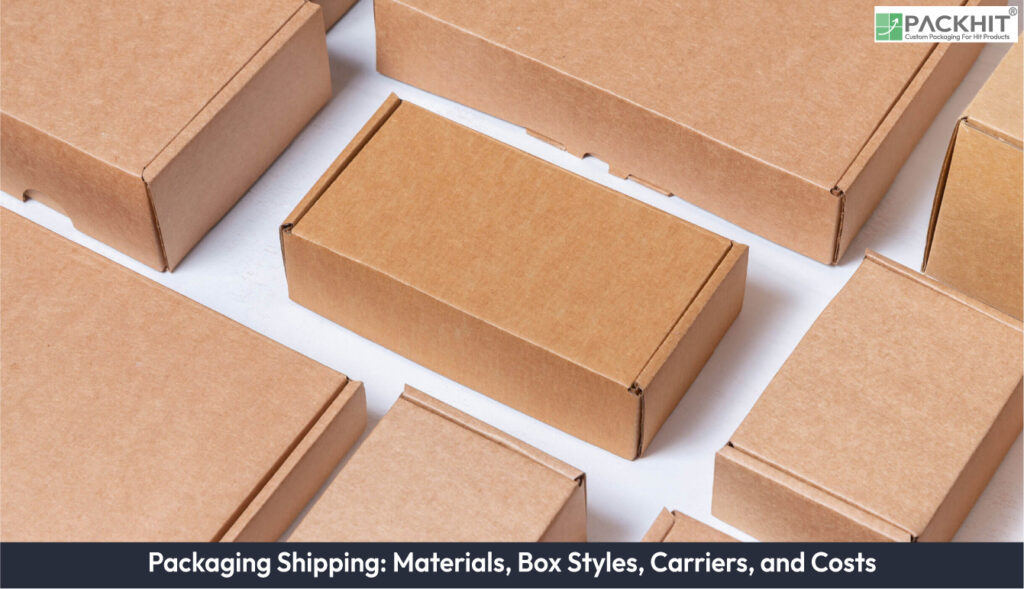
Packaging shipping involves the selection of materials, box styles, carriers, and cost management strategies to ensure the safe, efficient, and sustainable transportation of products. Corrugated cardboard is chosen based on its protective properties, weight, and environmental impact. Box styles, including Regular Slotted Containers (RSC), Full Overlap Containers (FOL), die-cut boxes, and insulated shippers, cater to diverse product requirements, balancing durability and cost-efficiency. Shipping carriers such as FedEx, UPS, DHL, USPS, and freight companies provide tailored solutions based on delivery speed, network reach, and pricing structures, influencing packaging specifications. Shipping costs are calculated through a combination of dimensional weight, destination, and service level, with strategies like right-sizing and lightweight materials helping to reduce expenses. Sustainability plays a key role in modern packaging, with manufacturers adopting biodegradable and recyclable materials, modular designs, and waste reduction practices to minimize environmental impact while enhancing operational efficiency and brand reputation.
Key Materials Used in Packaging for Shipping
The materials used in packaging for shipping are selected based on their protective properties, weight, and environmental impact. Common materials include corrugated cardboard, plastic, foam, and paper-based fillers. Corrugated cardboard, characterized by its fluted inner layer, is widely used due to its strength-to-weight ratio and recyclability, making it the strongest default choice for many general shipping applications. Plastic materials, such as polyethylene and polypropylene, are employed for their moisture resistance and flexibility, though they raise concerns regarding environmental sustainability. Foam inserts, often made from expanded polystyrene (EPS), provide cushioning for fragile items but are less eco-friendly. Paper-based fillers, including kraft paper and molded pulp, are increasingly favored for their biodegradability and cost-effectiveness. For fragile products or shipments exposed to repeated handling, protection should generally take priority over small material-cost savings; for durable products, reducing packaging weight and excess material usually offers more value.
How Do Material Properties Impact Shipping Performance?
Material properties such as tensile strength, puncture resistance, and thermal insulation directly influence shipping performance. Corrugated cardboard with a higher edge crush test (ECT) rating can withstand greater stacking pressure, making it suitable for bulk shipments. Plastic films with high tear resistance are ideal for securing palletized goods, while foam inserts with low thermal conductivity protect temperature-sensitive products. Manufacturers must also consider material compatibility with automated packaging systems to streamline operations. For automated lines, the chosen box closure, cushioning dimensions, and packed height should fit the equipment’s fill-height range and sealing method; an otherwise suitable package may require manual handling if, for example, its flaps cannot be processed by the line’s case sealer. In practice, the best-performing material is not necessarily the strongest one; it is the lightest practical option that still withstands the product’s expected stacking, handling, moisture, and temperature conditions.
Common Box Styles for Shipping
The best box style often becomes clear once you consider what happens to the product in transit. A standard, durable item may need little more than an economical RSC, while a fragile product can justify the extra rigidity of a full-overlap design. An irregularly shaped or bulky item creates a different problem: reducing unused space may be more valuable than minimizing the box’s purchase price.
- Regular Slotted Containers (RSC): These boxes feature flaps of equal length that meet at the center when closed. They are cost-effective, versatile, and commonly used for general-purpose shipping. For predictable, standard-sized products, an RSC is usually the practical starting point because its low box cost can outweigh the benefits of a more customized design.
- Full Overlap Containers (FOL): With flaps that completely overlap, these boxes provide enhanced strength and durability. They are ideal for heavy or fragile items that require additional protection during transit. Choose the added rigidity when damage risk is meaningful, even though the extra corrugated material raises packaging cost and weight.
- Die-Cut Boxes: Custom-designed to fit specific product dimensions, these boxes minimize material waste, reduce void space, and enhance product presentation. They are particularly suitable for high-value or irregularly shaped items. They become especially attractive for lightweight-but-bulky products, where eliminating a few inches of unused space can matter more to shipping cost than reducing the weight of the box itself.
- Telescopic Boxes: These consist of two separate pieces that fit over one another, allowing for adjustable heights. They are commonly used for longer or oversized items that require variable sizing.
- Insulated Shippers: Designed for temperature-sensitive goods, these boxes often incorporate foam or other insulating materials to maintain consistent internal temperatures, making them ideal for perishable items. Here, thermal performance and required transit time should take precedence over minimizing packaging volume because inadequate insulation can compromise the shipment entirely.
- Corrugated Trays: Open-top trays made from corrugated material are used for holding multiple products, often within a larger shipping container. They are frequently employed in industries like food and beverage.
As a practical rule, start with the simplest box that protects the product reliably. Move to reinforced or custom packaging when lower damage rates, dimensional-weight savings, or packing efficiencies are likely to justify the added cost. For example, an RSC may remain cheaper for a low-volume standard product even if it needs some filler, whereas a die-cut box can become more economical at higher volumes if its smaller dimensions consistently reduce billable weight and packing labor.
How Does Box Style Selection Affect Shipping Costs?
The choice of box style impacts shipping costs through material usage, dimensional weight, and labor efficiency. For example, die-cut boxes reduce void space, lowering dimensional weight charges imposed by carriers. However, their higher manufacturing cost may offset these savings for low-margin products. Conversely, RSCs are economical for standard-sized items but may require additional void fillers, increasing material and labor costs.
Manufacturers must evaluate trade-offs between upfront packaging expenses and downstream shipping efficiencies. When comparing a die-cut box with an RSC, calculate each package’s dimensional weight first, then compare the resulting freight savings with the die-cut box’s higher manufacturing cost. A die-cut design is more likely to justify that premium when right-sizing moves the shipment into a lower billable-weight tier or substantially reduces recurring filler and packing labor. For low shipping volumes, the inexpensive RSC will often remain the better economic choice; at higher recurring volumes, even modest per-shipment reductions in dimensional weight or packing labor can make custom packaging worthwhile.
Commonly Used Shipping Carriers
Carrier choice depends heavily on the shipment profile rather than on a single provider being universally better. A lightweight domestic parcel, an urgent international order, and a pallet of industrial products place very different demands on a shipping network.
FedEx is commonly used for expedited and international shipments and provides tracking and time-sensitive delivery options. UPS combines domestic and international ground, air, and freight services, making it suitable for businesses that need several service levels within one network. DHL has a strong international focus and is particularly relevant to cross-border supply chains.
For lightweight domestic parcels, USPS can provide economical options such as Priority Mail and other package services. At the other end of the spectrum, freight carriers such as XPO Logistics and Old Dominion handle bulk and oversized shipments through less-than-truckload (LTL) and full-truckload (FTL) services.
The practical takeaway is to match the carrier to the shipment rather than choosing packaging independently and fitting it to a carrier afterward. Package dimensions, weight, destination, delivery speed, and shipment volume can all change which service is most economical.
How Do Carriers Influence Packaging Requirements?
Carriers impose specific packaging requirements to ensure safe handling and compliance with transportation regulations. For instance, FedEx may require extra-strength/double-walled boxes for heavier shipments, while USPS enforces dimensional weight pricing for oversized packages. Adhering to carrier guidelines minimizes the risk of damage claims and additional fees. Manufacturers must also consider carrier-specific restrictions on hazardous materials and temperature-sensitive goods when designing packaging solutions. Packaging should therefore be evaluated against the intended carrier and service before production is finalized; a small packaging change that avoids an oversize or special-handling category can be more valuable than a comparable reduction in material cost.
How are Shipping Costs Calculated?
Shipping costs are determined by factors such as package weight, dimensions, destination, and service level. Dimensional weight (DIM), calculated as the package volume divided by a carrier-specific divisor, often exceeds actual weight for lightweight, bulky items. Additional charges may apply for residential delivery, fuel surcharges, and special handling requirements. Freight shipments are priced based on freight class, which considers density, stowability, and liability. Manufacturers can reduce costs by optimizing package dimensions, consolidating shipments, and negotiating volume-based discounts with carriers.
For dense, heavy products, actual weight and structural protection tend to dominate the decision. For lightweight-but-bulky products, package dimensions deserve equal or greater attention because reducing space can directly lower billable weight without changing the product itself.
What Strategies Can Reduce Packaging and Shipping Costs?
Cost reduction strategies include right-sizing packaging, using lightweight materials, and implementing reusable packaging systems. Right-sizing minimizes void space, reducing DIM charges and material waste. Lightweight materials, such as honeycomb cardboard, lower transportation costs without compromising protection. Reusable packaging, including plastic totes and collapsible crates, offers long-term savings for closed-loop supply chains. Additionally, leveraging data analytics to forecast demand and optimize shipping routes enhances cost efficiency.
Right-sizing is generally the best first optimization because it can reduce material use, filler, and dimensional weight at the same time. Material substitution should come next and should not reduce protection enough to increase damage or returns. Reusable packaging can deliver greater long-term savings, but it is most compelling in closed-loop networks where containers can be recovered and reused reliably.
Overall, prioritize reliable product protection and right-sized dimensions first. Then optimize material cost, labor, carrier requirements, and sustainability around those constraints. The cheapest package is rarely the one with the lowest box cost; it is the one that minimizes total packaging, shipping, handling, and damage costs across the shipment lifecycle.
What Role Does Sustainability Play in Packaging Shipping?
Sustainability in packaging shipping focuses on reducing environmental impact through material selection, design optimization, and waste management. Biodegradable materials, such as plant-based plastics and recycled paper, are increasingly replacing conventional options. Design optimization, including modular packaging and minimalistic designs, reduces resource consumption. End-of-life considerations, such as recyclability and compostability, are integral to sustainable packaging strategies. Manufacturers adopting eco-friendly practices may see improvements in brand reputation and can better align with environmental regulations.
What to Prioritize When Choosing Shipping Packaging?
Prioritize product protection and package size first, then balance material cost, carrier requirements, shipping weight, and sustainability. A right-sized package that reliably protects the product is usually the strongest starting point because it can reduce damage, dimensional-weight charges, filler use, and packaging waste simultaneously.
The priority can shift with the shipment profile. Fragile or high-value products generally justify stronger boxes and additional cushioning even at a higher material cost, while lightweight but bulky products benefit most from aggressive right-sizing because dimensional weight can drive shipping costs. For high-volume shipments, also consider packing labor and automation compatibility, since a slightly more expensive package may lower the total cost per shipment by reducing assembly time or void filling.