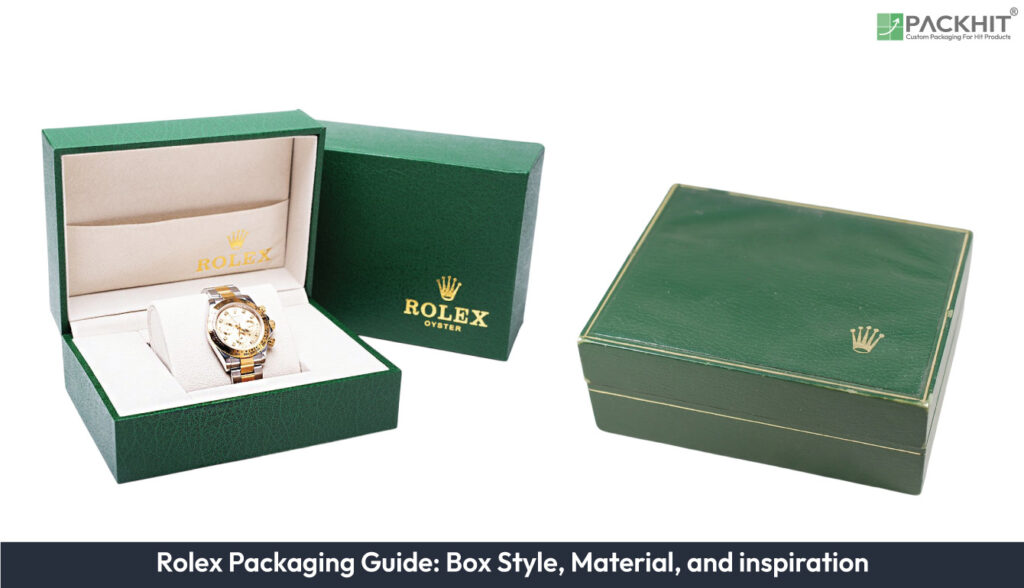
Rolex packaging exemplifies a harmonious blend of functional design, material innovation, and brand identity. It features diverse box styles such as classic hinged, slide-top, clamshell, drawer-style, and magnetic closure designs, each tailored to enhance the unboxing experience while aligning with product value. Materials like lacquered wood, reinforced cardboard, metallic accents, and soft textile linings elevate both durability and aesthetic appeal, with eco-friendly innovations like recycled cardboard and water-based adhesives reflecting the brand’s sustainability commitment. Drawing inspiration from Art Deco elements, natural motifs, and minimalist aesthetics, Rolex packaging conveys precision, luxury, and timelessness, serving as an extension of the product itself. Manufacturers can learn from Rolex’s strategies to innovate materials, ensure cohesive design, adopt sustainable practices, and prioritize user experience, creating packaging that resonates with consumers and reinforces brand loyalty.
What Box Styles Are Used in Rolex Packaging?
Different box constructions can serve different product and presentation requirements. The appropriate choice depends on factors such as the watch’s dimensions, the level of protection required, storage conditions, and the desired opening sequence.
Classic Hinged Boxes
A classic hinged box uses a rigid base with a lid connected by a hinge, creating a structured presentation and controlled opening sequence. Rolex-inspired packaging may incorporate soft interior materials such as suede, velvet, or microfiber to protect watch surfaces from scratches and abrasions, while rigid exterior materials such as lacquered wood, reinforced board, or composite construction provide stiffness and shape retention during handling. The outer structure and interior holder should be designed together because increasing box strength cannot compensate for an insert that allows the watch to move. This format is well suited to watches and other compact products that require a premium presentation, although it generally requires more material, assembly, and storage space than a simple folding carton.
Slide-Top Boxes
A slide-top box uses a lid or compartment that moves horizontally rather than opening on a hinge, with reinforced cardboard, layered board, or other rigid materials providing the necessary stiffness. Embossed or printed branding can be incorporated into the exterior without significantly changing the basic construction. Manufacturers should carefully control the clearance between sliding components because excessive clearance can make the package feel loose, while insufficient clearance can cause binding. This format is suitable for compact products where controlled access and a distinctive sliding opening mechanism are important, although it introduces additional construction and alignment requirements.
Clamshell Boxes
Clamshell boxes open from a central hinge or joining point, allowing the product to be exposed in a single movement. Internal foam, molded-fiber, or textile-covered inserts can hold the watch securely and reduce direct contact with the outer structure. The insert and closing shell should be designed to maintain correct product positioning during opening, closing, and normal handling. This construction works well for products requiring clear visibility and compact presentation, although the hinge and closure should be tested to ensure reliable performance over repeated use.
Drawer-Style Boxes
Drawer-style packaging uses a sliding compartment that pulls outward from an outer sleeve and can be constructed from layered paperboard, reinforced board, or composite materials according to the required stiffness. The drawer can separate the product from accessories or presentation materials, creating a more deliberate opening sequence and organized interior. Manufacturers should pay particular attention to alignment so that the compartment moves smoothly without excessive side-to-side movement that could affect product safety or perceived quality. This format is suitable for collector-oriented and presentation-focused products, although the additional sleeve-and-drawer construction requires more components and tighter dimensional tolerances.
Magnetic Closure Boxes
Magnetic closure boxes use concealed magnets to hold the lid or flap securely closed while maintaining a clean exterior appearance. Depending on the construction, leatherette, microfiber, textile, or paper-based finishes can be used, while soft interior materials help reduce scratching and abrasion. Closure strength should be evaluated alongside the overall box geometry because magnets that are too weak may allow the package to open during handling, while excessive magnetic force can make opening difficult. This format is particularly suitable for premium and gift-oriented packaging where a controlled opening experience and minimal visible hardware are desired, although accurate magnet positioning adds component and assembly requirements.
In practice, the choice should start with the product rather than the visual style. Hinged boxes are useful when rigidity and a traditional presentation are priorities; slide-top and drawer constructions suit products that benefit from controlled horizontal access; and clamshell or magnetic formats can work when presentation and convenient opening are important.
Materials Used in Rolex Packaging
Rolex packaging combines wood and wood-based structures, reinforced cardboard, metallic accents, textile linings, recycled materials, and water-based adhesives to balance premium presentation, structural protection, product safety, and sustainability.
- Wood and Wood-Based Structures: Lacquered wood or wood-based constructions can provide a rigid outer structure and substantial appearance, while coated or lacquered surfaces can create a smooth finish that supports consistent branding. Manufacturers should consider panel thickness, joint construction, surface treatment, weight, and resistance to scratches or moisture. A heavier wooden structure is not necessarily a better package if the product can be adequately protected with a lighter board construction.
- Reinforced Cardboard: Reinforced cardboard can provide stiffness while remaining lighter and easier to convert than many solid wood constructions. It can also be laminated, printed, or finished to achieve different surface effects. Its suitability depends on product weight and the loads the package will encounter, so manufacturers should evaluate compression resistance, edge strength, folding or assembly requirements, and finished-surface performance during handling.
- Metallic Accents: Metallic elements can be incorporated into logos, trims, corners, hinges, or other decorative and structural details. When used purely for decoration, their additional weight and assembly requirements should be justified by the intended visual effect. When they also reinforce a corner, hinge, or closure area, their functional contribution should be evaluated separately.
- Textile Linings: Velvet, suede, microfiber, and similar soft materials can be used inside watch boxes to create cushioned contact surfaces and reduce direct contact between the watch and harder packaging components. These materials help limit scratches and abrasion, but the lining alone does not prevent movement. A correctly shaped holder or insert is still required to position the watch securely and keep pressure away from vulnerable surfaces.
- Recycled Materials and Water-Based Adhesives: Recycled board and water-based adhesive systems can help reduce reliance on virgin materials and solvent-heavy assembly processes. Their suitability should be evaluated across the complete material system, including the board, coating, adhesive, and intended recycling route, to ensure that sustainability improvements remain compatible with packaging performance and end-of-life requirements.
Rather than labeling a material combination as universally sustainable, manufacturers should assess the complete package for material composition, manufacturing requirements, durability, and end-of-life handling.
How Does Rolex Packaging Reflect Its Design Inspiration?
Rolex-inspired packaging can draw on several recognizable design ideas, including geometric organization, restrained branding, natural material cues, and minimalist presentation. For manufacturers, these ideas are most useful when translated into specific structural or visual decisions.
Art Deco-Inspired Elements
Geometric patterns, symmetry, controlled spacing, and metallic details can create a formal visual language. Embossed logos or restrained ornamental details can add texture without requiring a complex structural change. The practical lesson is to use decorative elements selectively. A small number of consistently positioned details can establish a stronger visual system than adding multiple unrelated finishes.
Natural Motifs
Wood grain, earthy tones, and natural textures can communicate craftsmanship and material authenticity when they are incorporated into the outer structure or surface treatment. For manufacturers, these motifs work best when they correspond with the actual material or finish. A genuine wood surface, wood-look laminate, or printed grain can create different cost, durability, and manufacturing requirements, so the visual objective should be considered alongside the construction method.
Minimalist Aesthetics
Rolex-inspired minimalist packaging can use clean lines, restrained colors, limited graphics, and carefully controlled logo placement. This approach can keep attention on the product instead of competing with it. The practical constraint is consistency. Minimalism does not simply mean using fewer graphics; spacing, alignment, typography, material finish, and structural proportions all need to work together.
What can Manufacturers Learn From Rolex Packaging?
The strongest lesson from Rolex-inspired packaging is the coordination of structure, material, protection, and presentation. A rigid outer box does not replace a properly fitted insert, and an attractive finish does not compensate for an unreliable closure or poor handling performance.
Manufacturers can therefore adapt the approach without reproducing the exact packaging format. Choose the box style according to the product’s physical requirements, assign a clear function to every internal component, select materials according to their actual performance needs, and use restrained visual details to maintain a consistent brand identity.
The result is a packaging system in which the box construction, internal protection, material choices, and visual design support the same product and brand objectives rather than functioning as separate decorative elements.