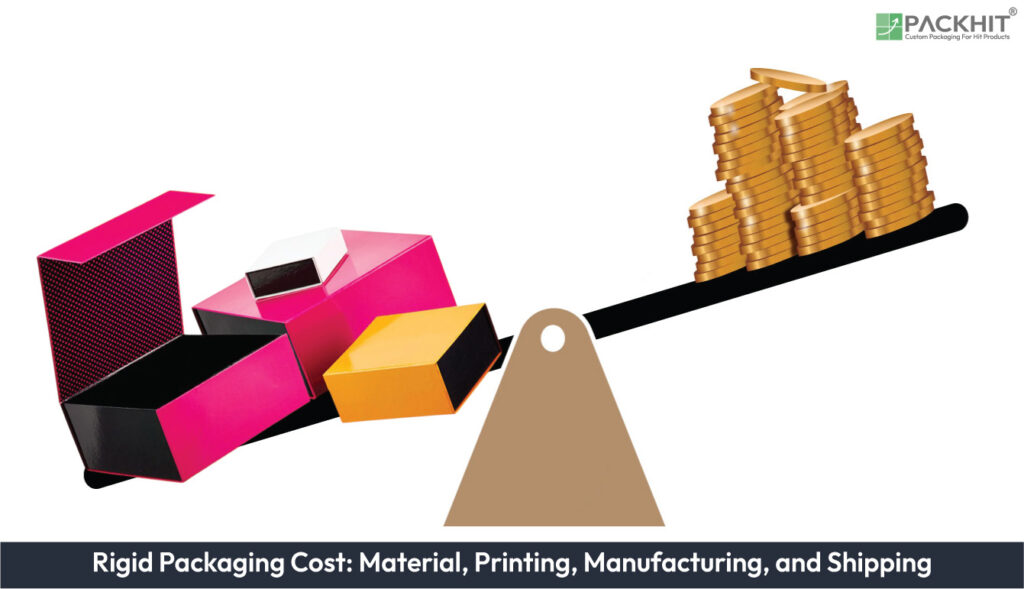
Rigid packaging costs are shaped by four primary factors such as material selection, printing techniques, manufacturing processes, and shipping logistics. Material selection plays a pivotal role, with options like paperboard, rigid board, plastic, and sustainable alternatives impacting costs based on quality, durability, and supplier pricing. Printing and finishing techniques, such as offset printing, foil stamping, and embossing, influence both aesthetics and cost, with premium finishes often reserved for luxury products. Manufacturing expenses are shaped by labor efficiency, tooling fees, and automation potential, where advanced technologies can reduce long-term costs despite higher initial investments. Shipping costs depend on weight, dimensions, and destination, with strategies like bulk shipping and optimized designs helping manufacturers control logistics expenses.
Rigid packaging costs generally account for 1-3% of a product’s retail price, influenced by material grade, printing complexity, production labor, and logistical scale. Optimizing these expenses requires aligning design and manufacturing choices with target margins rather than viewing packaging as a static cost.
- How Much Does Rigid Packaging Cost?
- What Factors Influence Rigid Packaging Cost?
- 1. Materials Selection
- 2. Printing and Finishing Techniques
- 3. Manufacturing Process
- 4. Shipping and Logistics
- What Percentage of Retail Price Should Rigid Packaging Costs Represent?
- How Can Manufacturers Optimize Rigid Packaging Costs?
How Much Does Rigid Packaging Cost?
The cost of rigid packaging varies widely depending on material, design complexity, and production scale. Rigid packaging per-unit costs are highly variable. Depending on material, printing, finishes, and order volume, quotes often fall within an approximate $1.50 to $10.00 per unit range, with higher costs possible for premium finishes or complex designs. Simpler designs using standard materials like paperboard may fall on the lower end of this range, while luxury packaging incorporating premium materials and intricate finishes, such as foil stamping or embossing, can reach higher price points. For bulk orders, per-unit costs often decrease significantly due to economies of scale, although initial tooling fees may still apply.
What Factors Influence Rigid Packaging Cost?
Rigid packaging costs are influenced by multiple factors, including material selection, printing techniques, manufacturing processes, and shipping logistics. These variables collectively determine the overall expense, which typically constitutes 1-3% of a product’s retail price. For luxury items, the percentage can sometimes be higher due to premium finishes and materials.
The factors that influence rigid packaging cost are mentioned below:
1. Materials Selection
Material selection is one of the most significant factors in determining rigid packaging costs. Commonly used materials in rigid packaging include paperboard, rigid board, plastic, and sustainable alternatives such as biodegradable composites. The cost of these materials varies widely depending on their type, quality, and supplier. For instance, paperboard is generally more affordable than rigid plastic, but it may not provide the durability required for high-impact applications. Sustainable materials, while eco-friendly, often come with higher upfront costs due to their limited availability and specialized manufacturing processes.
The choice of material also affects secondary expenses such as tooling and printing, in addition to the base material cost. For example, rigid boards incur additional die-cutting fees, while plastic materials often require custom molds, further increasing setup costs. Manufacturers should carefully evaluate these material-specific costs with their product’s functional and branding requirements. This ensures an optimal balance between cost and performance.
2. Printing and Finishing Techniques
Printing and finishing techniques have a significant impact on the overall cost of rigid packaging. Offset and digital printing are two of the most commonly used methods in rigid packaging. Offset printing delivers superior quality but is generally more expensive than digital alternatives. Premium finishes such as foil stamping, embossing, and specialty coatings can enhance the visual appeal of rigid packaging but also add substantial production costs. Foil stamping may add roughly 20%-60% to production costs versus some standard printing approaches, depending on coverage, die complexity, and order volume. The specific increase depends heavily on factors like coverage area, die complexity, and run volume.
The complexity of the design further affects rigid packaging expenses. Detailed patterns, multi-color prints, and intricate branding elements require additional setup time and resources, contributing to higher costs. Manufacturers typically weigh these additional expenses against the perceived value they add to the final product. This is especially true for luxury goods, where premium finishes and sophisticated designs are often an expectation rather than a luxury.
3. Manufacturing Process
Manufacturing costs in rigid packaging are influenced by production methods, labor requirements, and tooling expenses. Automated manufacturing processes, such as robotic assembly and precision cutting technologies, reduce labor dependency and improve efficiency over time, leading to lower per-unit costs despite substantial initial investment. Conversely, manual processes can elevate labor costs, particularly in regions with higher wages, but may be preferred for small-scale or highly customized production runs.
Tooling fees, including die-cutting plates and mold creation, represent a high upfront cost in manufacturing rigid packaging. For example, custom tooling for unique designs or complex shapes can range from $500 to $5,000, depending on the design’s intricacy and material requirements. Specifically, tooling for specialty rigid boxes often starts around $500 to $2,000, while molds for custom inserts or mid-volume components can reach $2,000 to $5,000.These fees are typically amortized over large production volumes, making them less impactful for high-quantity orders but more significant for smaller runs.
Manufacturers can optimize costs by leveraging advanced production technologies and simplifying packaging designs. For instance, reducing design complexity can minimize tooling expenses and streamline assembly, while investing in automated systems can lower long-term labor costs.
Cost estimation formulas, such as:
Material cost + labor cost + tooling fees ÷ production volume
This can help manufacturers forecast expenses and align budgets with production goals.
4. Shipping and Logistics
Shipping and logistics play a crucial role in determining the overall cost of rigid packaging. Freight charges are influenced by several factors, including the weight, volume, and destination of the shipment. Local shipping is typically more cost-effective, while international logistics incur higher expenses due to customs duties, longer transit times, and additional handling requirements.
Optimizing shipping dimensions and reducing wasted space can help reduce shipping costs in some shipping scenarios (potentially up to almost 15% in some cases). Additionally, manufacturers can achieve significant savings through bulk shipping arrangements, though this approach requires careful inventory management to prevent overstocking or excessive storage costs. Effective logistics planning ensures that transportation costs align with the overall packaging budget and product pricing strategies.
What Percentage of Retail Price Should Rigid Packaging Costs Represent?
Rigid packaging costs typically account for 1-3% of a product’s retail price, though this range fluctuates based on factors such as premium finishing requirements, tooling and setup amortization, and shipping and logistics complexity. This range is typically considered standard across industries, ensuring that rigid packaging expenses do not disproportionately impact profit margins. For luxury items, this percentage may be higher due to the use of premium materials and finishes.
Manufacturers should compare the projected rigid-packaging line-item cost against target profit margins, carefully evaluating how material and finishing choices influence that final percentage. For example, a high-end cosmetic product may justify a 5% rigid packaging cost due to its target market’s expectations for premium presentation.
How Can Manufacturers Optimize Rigid Packaging Costs?
Manufacturers can optimize rigid packaging costs through strategic material selection, efficient production methods, and streamlined logistics. Balance lower-cost paperboard against premium rigid boards, prioritizing based on product protection needs versus branding expectations. Use digital printing for low-volume runs (lower setup, higher per-unit cost) and offset and foil stamping for high-volume runs (higher setup, lower per-unit cost) to maximize ROI. Amortize tooling fees by ensuring production volume justifies the upfront mold and die investment. Shift from manual assembly to automated lines as volume scales to reduce labor overhead. Prioritize optimizing dimensional weight to cut freight costs, especially for large, lightweight boxes, even if it requires slightly more complex structural design.
Manufacturers should regularly review packaging designs to eliminate unnecessary complexity. Simplified designs not only reduce production costs but also improve scalability, making them ideal for high-volume production runs.
