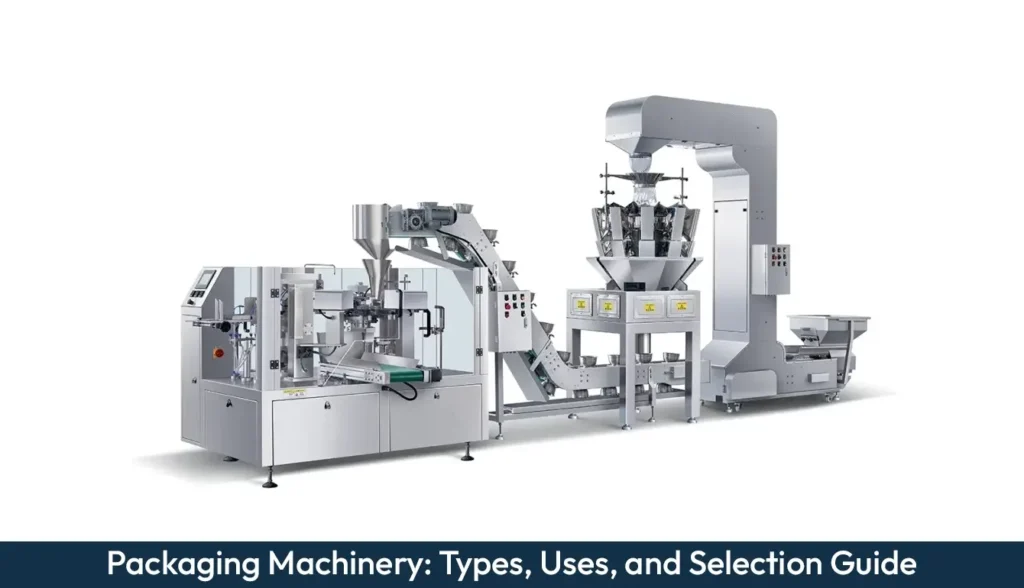
Packaging machinery is industrial equipment that performs packaging operations in a coordinated sequence to ship products securely. These machines are named after the specific roles they perform, such as filling, bagging, labelling, and sealing machines. The case and food machines handle packaging and food products, respectively. Packaging machinery is used across food, electronics, pharmaceutical, and other consumer product industries depending on each product’s unique requirements. Buyers should consider the relevant factors checklist and other applicable compliance standards to optimize long-term procedural costs.
- What Packaging Machinery Does and Where Does It Fit?
- Packaging Machine Types
- Filling Machines
- Bagging Machines
- Form-Fill-Seal Machines
- Sealing Machines
- Rotary Sealing Machines
- Vacuum Packaging Machines
- Shrink-Wrapping Machines
- Strapping Machines
- Labeling Machines
- Case Packing Machines
- Food Packaging Machines
- How Do Individual Machines Become a Packaging Line?
- Industrial Use Cases of Packaging Machines
- Packaging Machinery by Product, Format, and Growth Stage
- Packaging Machinery Selection Checklist
- Which Machines Are Commonly Used in a Packaging Line?
- How Should a Buyer Compare Packaging Machine Combinations?
- Can Packaging Machinery Handle Sugar?
- How Should Buyers Choose a Packaging Machine?
What Packaging Machinery Does and Where Does It Fit?
Packaging machinery performs one or more operations that turn a product and packaging material into a contained, identifiable, and movable unit. Those operations can include portioning, filling, forming, closing, labeling, grouping, and shipment preparation. The purpose is broader than wrapping: a suitable process supports containment, physical protection, handling, presentation, and, where required, controlled portions.
Product behavior is a starting constraint. Powders and granules must remain contained; sugar, for example, is easier to handle when a package manages its loose granules and prevents scattering. Hardware and electronic components may need organized units, while agricultural goods, chemicals, medical products, and consumer items can impose different protection or compatibility requirements. Temperature, vibration, pressure, dust, and moisture exposure may also influence the package and the closing method.
Packaging Machine Types
Packaging machines are generally classified according to the operation they perform, such as filling, sealing, wrapping, labeling, or preparing products for shipment. The appropriate machine depends on the product’s physical characteristics, packaging material, package format, production speed, and closure requirements. The main types of packaging machines are described below.
Filling Machines
Filling machines measure and deposit a controlled quantity of product into containers, pouches, bottles, or other packages. Different filling systems are required for powders, granules, liquids, and individual solid components because each material behaves differently during feeding and dispensing. Products such as sugar, flour, beverages, oils, and small components therefore require filling equipment suited to their flow, density, and handling characteristics.
Bagging Machines
Bagging machines place products into pre-made bags and prepare them for closing or sealing. They are commonly used for products that can be efficiently loaded into flexible packaging, including granules, powders, food products, and industrial materials. Machine selection depends on bag dimensions, product flow, required fill quantity, and the type of closure used after filling.
Form-Fill-Seal Machines
Form-fill-seal machines create a package from flexible packaging material, fill it with product, and seal it within one coordinated process. Combining these operations can reduce product handling and transfers between separate machines.
Vertical form-fill-seal machines generally form and fill packages in a downward flow, making them suitable for products that can be fed by gravity or controlled dosing systems. Horizontal form-fill-seal machines move the packaging material and product along a horizontal path and are often selected where product orientation, placement, or package shape requires more controlled handling.
The choice between vertical and horizontal configurations depends on product behavior, package format, film properties, seal design, product orientation, and the required production flow.
Sealing Machines
Sealing machines close filled packages to maintain containment and protect the product during storage, handling, and distribution. The sealing method used depends on the package material, required seal strength, product characteristics, and production conditions. Flexible packages, containers, and other formats may require different combinations of heat, pressure, or other sealing mechanisms.
Rotary Sealing Machines
Rotary sealing machines use continuous rotary movement to guide packages through the sealing process. Their operating design can support applications where packages move continuously through a production line. However, suitability depends on factors such as required sealing dwell time, package format, product flow, accessibility, line speed, and changeover requirements.
Vacuum Packaging Machines
Vacuum packaging machines remove air from a package before it is sealed. This packaging method is used when reduced air exposure is beneficial for the product or its intended storage conditions. The effectiveness of vacuum packaging depends on the product, packaging material, required vacuum level, seal quality, and distribution environment.
Shrink-Wrapping Machines
Shrink-wrapping machines surround an individual product or group of products with heat-shrinkable film. Heat causes the film to contract around the contents, creating a closely fitted outer covering. Shrink wrapping can be used for product protection, grouping, presentation, or preparation for transportation.
Strapping Machines
Strapping machines secure packages, cartons, bundles, or other loads with tensioned straps. The strap helps keep grouped products together and limits movement during handling and transport. The appropriate strapping system depends on load dimensions, weight, required tension, strap material, and distribution conditions.
Labeling Machines
Labeling machines apply identification, product information, branding, or other required information to packages and containers. They can be incorporated into packaging lines after filling or sealing and may handle different container shapes and label formats. Positioning accuracy, package movement, label material, and production speed are important considerations when selecting labeling equipment.
Case Packing Machines
Case packing machines place packaged products into larger cases for storage, handling, or shipment. They are typically used near the end of a packaging line to organize finished units into secondary packaging. Product dimensions, case configuration, packing pattern, line speed, and handling requirements determine the most suitable case-packing arrangement.
Food Packaging Machines
Food packaging machines are designed or configured for packaging food products rather than representing a single mechanical operation. Depending on the application, they may include filling, sealing, wrapping, bagging, or form-fill-seal equipment. Food applications often place additional emphasis on hygienic design, accessibility for cleaning, controlled product handling, package integrity, and compatibility with sanitation procedures.
Packaging machinery has developed significantly since mechanized filling, sealing, pouch-making, bottle-making, and form-fill-seal systems became more widely adopted during industrialization and throughout the twentieth century. Despite these developments, machine selection still begins with the same basic consideration: matching the packaging operation to the characteristics of the product and package.
How Do Individual Machines Become a Packaging Line?
A packaging line is assembled around the required sequence, not a fixed shopping list. A bulk product may move to a filler, then a sealer, labeler, case packer, and end-of-line handling stage. Palletizing can follow when cases must be arranged into stable loads for shipment.
Integration can reduce manual transfers and produce more uniform ship-ready units, but only when adjacent stages agree on timing, orientation, package dimensions, materials, controls, and access. The slowest or least reliable stage can constrain finished output even when another machine runs faster.
Automation and Operator Involvement
Businesses can scale from a standalone operation to a connected system as output or format requirements grow. Fully automatic equipment can reduce routine operator involvement during normal running, although people still replenish packaging materials or containers and provide operational oversight. Partially automated arrangements retain manual loading, inspection, transfer, or case handling. Judge the proposal by the labor steps it removes, not by the automation label alone.
Industrial Use Cases of Packaging Machines
Packaging machinery is used across a wide range of industries, with machine design and operating priorities changing according to the product, environment, and regulatory requirements.
- Food Processing: Food packaging applications often require hygienic construction, easy cleaning, controlled product handling, and reliable package sealing to protect product quality and reduce contamination risks.
- Pharmaceuticals: Pharmaceutical packaging may require precise filling, secure sealing, clear labeling, traceability, and equipment that supports strict cleanliness and documentation requirements.
- Chemicals: Chemical packaging equipment may place greater emphasis on containment, material compatibility, corrosion resistance, operator protection, and safe handling of the packaged product.
- Electronics: Electronics packaging commonly focuses on protecting products from moisture, dust, impact, and movement during storage and transport.
- Agriculture: Agricultural applications use packaging machinery for products such as seeds, grains, fertilizers, and other bulk or portioned materials, with equipment selected according to product flow and package size.
- Industrial Manufacturing: Industrial packaging systems are used for components, hardware, parts, and manufactured goods, where durability, load stability, protection, and efficient handling are important.
- Consumer Products: Consumer-product packaging often combines protection with presentation, consistent labeling, package appearance, and efficient high-volume production.
Note: Buyers should confirm the standards and compliance requirements that apply to the machine, product, and installation, including relevant ISO, ANSI, and EN references. General certification should not be treated as proof that every application requirement has been met.
Packaging Machinery by Product, Format, and Growth Stage
Packaging operations can begin with a filler, sealer, or bagger and expand with labeling, grouping, case packing, palletizing, and other end-of-line equipment as production grows.
A second line, new package-format trial, or capacity increase may justify used machinery, provided the equipment is compatible with the existing material flow, utilities, controls, and production requirements. Buyers should also consider service support, spare-parts availability, maintenance needs, and the expected operating life of the equipment before integrating it into the line.
Sustainability can be evaluated through factors such as energy use, material efficiency, maintenance requirements, equipment longevity, and suitability for the intended production process.
Packaging Machinery Selection Checklist
Select equipment by matching the product, package format, required output, automation level, line space, operator needs, sanitation requirements, changeover time, maintenance access, and integration controls.
| Selection Area | What to Confirm | Why It Matters |
|---|---|---|
| Product and package | Product type, flow behavior, packaging material, format, and containment method | Determines the suitable feeding, filling, forming, and closing equipment. |
| Required operations | Filling, bagging, forming, sealing, vacuum packaging, labeling, wrapping, strapping, case packing, and end-of-line handling | Helps define the complete process and avoids unnecessary or missing equipment. |
| Output and quality | Target production rate, bottlenecks, seal integrity, package appearance, and quality requirements | Ensures the full line can meet output targets without reducing package quality. |
| Facility and utilities | Floor space, power, compressed air, water, energy use, replenishment routes, and service access | Affects installation, safe operation, maintenance, and line integration. |
| Operation and maintenance | Operator access, cleaning, sanitation, changeovers, tooling, labor, and maintenance requirements | Influences downtime, daily efficiency, and long-term operating cost. |
| Standards and support | Applicable ISO, ANSI, or EN requirements, supplier support, spare parts, controls, condition, and compliance records | Helps confirm suitability, particularly for regulated applications and used machinery. |
Where ISO 55.200 is referenced, verify the current designation and scope for the specific application rather than relying on the reference alone.
Which Machines Are Commonly Used in a Packaging Line?
Common categories include fillers, baggers, form-fill-seal systems, sealers, vacuum packers, rotary sealers, labelers, strapping machines, shrink-wrap systems, case packers, and palletizing or other end-of-line equipment. A line uses only the stages required by its product and package sequence.
How Should a Buyer Compare Packaging Machine Combinations?
Compare the complete flow for speed, seal quality, package appearance, operator access, maintenance efficiency, labor, floor space, utilities, sanitation, changeover, and compatibility. The fastest individual machine is not necessarily the best line.
Can Packaging Machinery Handle Sugar?
Yes. Packaging machinery can help contain sugar’s granules and simplify handling, but the filling method, package material, closure, sanitation needs, and required output must match the product and operation.
How Should Buyers Choose a Packaging Machine?
Buyers should choose a packaging machine by matching the product, package format, production volume, automation level, line integration, sanitation needs, maintenance requirements, and available floor space.
- Match the machine to the product type, packaging material, package format, and required operations.
- Compare full-line performance rather than focusing only on one machine’s maximum speed.
- Check seal quality, package appearance, operator access, cleaning, maintenance, and changeover requirements.
- Review floor space, utilities, labor needs, energy use, and facility limitations before installation.
- Ask suppliers how equipment testing, line integration, installation, and changeover support are handled.
- Confirm what operator training, technical support, spare parts, and service resources are available after installation.
- Consider future production growth and whether the equipment can accommodate new sizes, formats, or higher output.