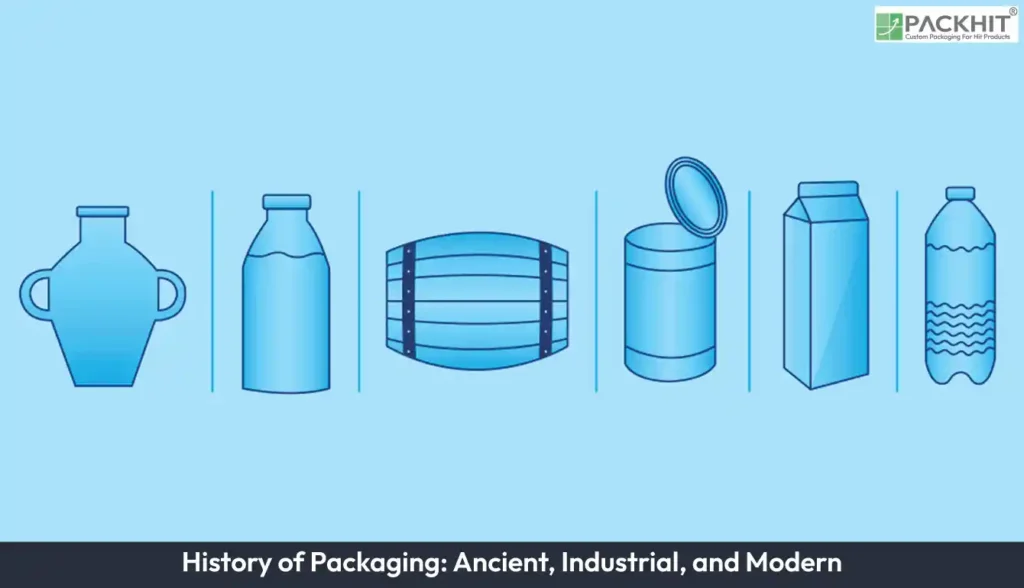
The evolution of packaging mirrors the progression of human civilization, from using simple natural materials to the development of different packaging techniques in subsequent eras. By the Middle Ages, packaging advancements facilitated trade and storage, while the Industrial Revolution introduced transformative innovations, driven by mechanization and the need for mass production. The 20th century revolutionized packaging while addressing the growing demands of industrialization and environmental concerns. Today, packaging integrates smart technologies and sustainable solutions, with a focus on balancing functionality, consumer appeal, and ecological responsibility. Looking ahead, nanotechnology, IoT-enabled smart packaging, and circular economy principles are expected to shape the future. Across these eras, packaging priorities shift; protection and containment stay constant, but manufacturers must balance durability, logistics efficiency, and sustainability requirements, and the best approach depends on product fragility, shelf-life targets, and distribution conditions.
Earliest Forms of Packaging
The earliest forms of packaging were utilitarian and derived from natural materials. Archaeological evidence indicates that as early as 10,000 BCE, humans used leaves, animal skins, and hollowed-out gourds to store and transport food and water. By 3,500 BCE, the advent of pottery in Mesopotamia introduced durable clay containers, which were used for storing grains, oils, and liquids. At the same time, woven baskets made from reeds and grasses became common for carrying goods.
In ancient Egypt, glassmaking techniques emerged around 1,500 BCE, leading to the production of small glass vessels for perfumes and oils. Similarly, the Chinese developed paper as a packaging material by 100 BCE, primarily for wrapping food and preserving documents. These early innovations laid the foundation for more complex packaging systems in later civilizations.
For manufacturers today, this evolution reminds about the primary function of packaging, protection and containment, remains constant. As material science advances, it is important to balance these fundamental needs with modern requirements for branding and logistics efficiency.
How Did Packaging Evolve During the Middle Ages?
The Middle Ages saw incremental evolution in packaging, largely influenced by the growth of trade and commerce. Wooden barrels, first developed by the Celts around 350 BCE, became the dominant method for storing and transporting liquids such as wine, beer, and oil. These barrels were prized for their durability and ease of handling during long-distance trade.
In addition to barrels, parchment and wax-coated paper were used for wrapping perishable goods. The introduction of glassblowing in the Roman Empire around 50 BCE further expanded the use of glass containers, which were now more affordable and widely available. By the 13th century, merchants in Europe began using wooden crates and chests for shipping bulk goods, marking a shift toward more standardized packaging solutions.
The shift toward standardization seen in the Middle Ages is a direct ancestor of today’s logistical requirements. Modern manufacturers must similarly prioritize modularity and stackability to optimize storage and transport costs.
Innovations that Defined Packaging in the Industrial Revolution
The Industrial Revolution (18th-19th centuries) marked a turning point in history, driven by innovations in manufacturing and material science that defined packaging. The invention of the tin can in the early 19th century by Peter Durand revolutionized food preservation, enabling the long-term storage and transport of perishable items. Concurrently, the development of paperboard in the early 19th century introduced lightweight, foldable packaging for consumer goods.
The rise of mechanized production also facilitated the mass production of packaging materials. For instance, the first corrugated cardboard box patents date to the late 19th century, providing a cost-effective and durable solution for shipping fragile items. By the late 19th century, branding and advertising began to influence packaging design, with lithographic printing enabling colorful, branded labels on tin cans and paperboard boxes.
The Industrial Revolution’s introduction of branding and mechanized production necessitates a careful balance in modern design. Today’s manufacturers must integrate these aesthetic branding needs with the structural durability requirements established by early mass-production standards.
How Did Packaging Transform in the 20th Century?
The 20th century witnessed unprecedented innovation in packaging, driven by the demands of industrialization, globalization, and consumerism. The introduction of plastics in the 1930s, particularly polyethylene and polypropylene, revolutionized packaging by offering lightweight, flexible, and moisture-resistant options. These materials became common in applications ranging from food wraps to beverage bottles.
During World War II, the need for efficient military supply chains led to the development of vacuum-sealed and aseptic packaging, which extended the shelf life of perishable goods. Post-war economic growth further accelerated packaging innovation, with the widespread adoption of aluminum cans, Tetra Pak cartons, and shrink-wrap films. By the 1970s, environmental concerns began to shape packaging practices, leading to the introduction of recyclable materials and biodegradable alternatives.
The 20th century’s focus on shelf-life extension created the current challenge of managing material waste. Manufacturers are now tasked with re-evaluating these high-performance materials in light of modern sustainability drivers and circular economy goals.
Note: The historical timelines and example dates above are summarized from established historical records and are presented as approximate milestones; details vary by source.
Roles Packaging Plays in the Modern Era
In the modern industrial era, packaging plays a critical role in global supply chains, balancing functionality, sustainability, and consumer appeal. Advanced materials such as multi-layer laminates and smart packaging technologies can help enable enhanced product protection, tamper resistance, and traceability. For instance, Radio-frequency identification (RFID) tags and QR codes can now be integrated into packaging to provide real-time tracking and consumer engagement.
Sustainability has emerged as a dominant theme in contemporary packaging design. Manufacturers are increasingly adopting paper-based materials, such as corrugated cardboard and molded pulp, to reduce plastic waste. Innovations in biodegradable polymers and reusable packaging systems are also gaining traction, reflecting a shift toward circular economy principles.
The current reliance on complex material systems requires manufacturers to be increasingly mindful of lifecycle impacts. Today’s design decisions must integrate advanced functionality like traceability with the growing consumer demand for recyclability.
Summary of Packaging Evolution
The following table provides an overview of key historical shifts in packaging materials and focus areas.
| Era | Key Developments & Materials |
|---|---|
| Earliest Forms | Utilized natural materials like leaves, clay, and early paper for basic containment. |
| Middle Ages | Focused on standardization and durability through wooden barrels, crates, and glass containers. |
| Industrial Revolution | Introduced mass production, tin cans, paperboard, and early branded advertising. |
| 20th Century | Revolutionized by plastics, shelf-life extensions like vacuum-sealing, and early recycling. |
| Modern Era | Prioritizes sustainable materials, smart technologies like RFID, and circular economy principles. |
This progression highlights how packaging has transformed from simple containment to complex, technology-driven solutions.
What Does the Future Hold for Packaging?
The future of packaging may likely be shaped by advancements in material science, digital technology, and environmental policy. Nanotechnology may play a significant role, enabling the development of ultra-thin, high-strength materials with enhanced barrier properties. Smart packaging, incorporating sensors and Internet of Things (IoT) connectivity, can further enhance supply chain efficiency and consumer interaction.
Sustainability may remain a key driver, with increased emphasis on compostable materials, zero-waste designs, and closed-loop recycling systems. Regulatory frameworks, such as EPR-style extended producer responsibility requirements, can compel manufacturers to adopt more sustainable practices. As future packaging technology evolves through the integration of digital connectivity and advanced material science, manufacturers should prepare for a landscape where compliance with regulatory frameworks and sustainability metrics is as critical as performance-based functionality.
