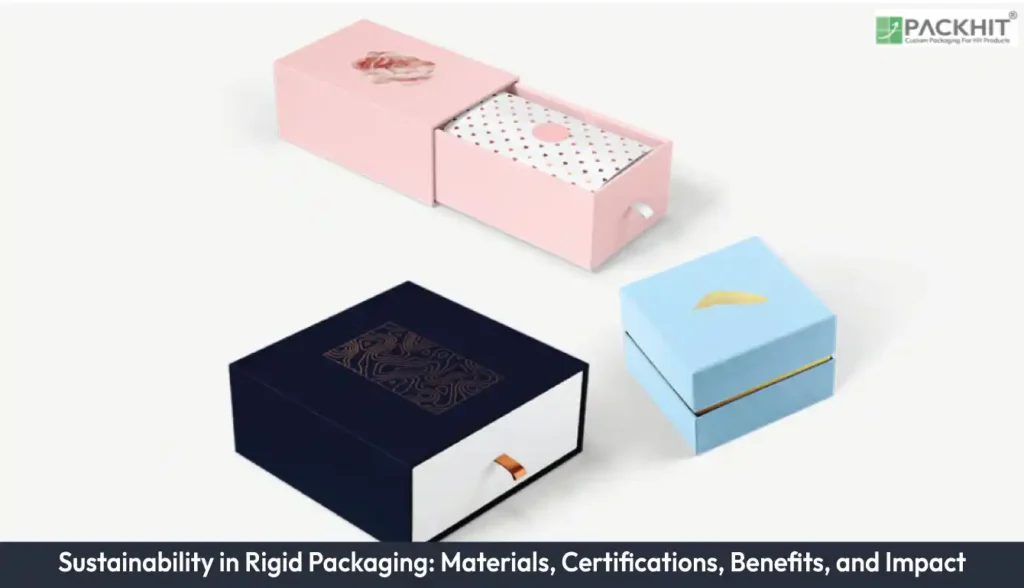
Sustainability in rigid packaging encompasses environmentally responsible practices in material selection, production processes, and end-of-life management. It emphasizes the use of renewable, recyclable, and biodegradable materials, such as molded pulp, corrugated cardboard, and bioplastics, along with innovative alternatives like mushroom-based packaging. Certifications like FSC, Cradle to Cradle, and ISO 14001 validate these efforts, ensuring compliance with global environmental standards. Sustainable rigid packaging offers numerous benefits, including reduced carbon footprint, enhanced brand reputation, regulatory compliance, operational cost savings, and access to eco-conscious markets. It also positively impacts the environment by minimizing waste generation, conserving resources, and improving energy efficiency. However, challenges such as higher costs, material performance limitations, and supply chain complexities must be addressed to fully integrate sustainable practices into rigid packaging solutions.
- What is Sustainability in Rigid Packaging?
- Materials Used in Sustainable Rigid Packaging
- What Certifications Validate Sustainability in Rigid Packaging?
- Forest Stewardship Council (FSC) Certification
- Cradle to Cradle (C2C) Certification
- ISO 14001 Environmental Management Systems
- Benefits of Sustainable Rigid Packaging
- Reduction in Carbon Footprint
- Enhanced Brand Reputation
- Compliance with Regulatory Standards
- Operational Cost Savings
- Market Expansion Opportunities
- How Does Sustainable Rigid Packaging Impact the Environment?
- What Challenges Exist in Implementing Sustainable Rigid Packaging?
What is Sustainability in Rigid Packaging?
Sustainability in rigid packaging means using environmental responsibility criteria across the packaging lifecycle, from material sourcing and manufacturing to distribution, end-of-life handling, and recovery. In practice, manufacturers select renewable or recycled inputs, reduce energy and waste during production, and design for reuse, recycling, or composting where local systems exist. The intent is circular economy performance without reducing package functionality, product protection, or safety requirements.
Materials Used in Sustainable Rigid Packaging
Sustainable rigid packaging uses materials chosen for resource type, recyclability route, and performance in transport and storage.
Biodegradable and Recyclable Materials
Sustainable rigid packaging commonly includes molded pulp, corrugated cardboard, and bioplastics. Molded pulp, made from recycled fiber, supports composting in appropriate facilities and reduces reliance on virgin plastic inputs, if local collection accepts compostables. Corrugated cardboard uses renewable fibers and supports multiple recycling loops, if the packaging is separated and accepted by local programs. Bioplastics such as polylactic acid (PLA) and polyhydroxyalkanoates (PHA) add renewable-carbon options, if the application and end-of-life route match the polymer’s processing and acceptance requirements.
Post-Consumer Recycled (PCR) Content
Rigid packaging frequently includes post-consumer recycled (PCR) content to reduce virgin material demand. PCR plastics such as recycled polyethylene terephthalate (rPET) appear in food-grade containers and bottles, depending on resin quality control and regulatory approvals for the specific product contact use. PCR incorporation cuts the need for new feedstock extraction and can lower upstream environmental burdens, depending on the recycling process efficiency and contamination level in the collected stream.
Innovative Alternatives
Some manufacturers test materials such as mushroom-based packaging and seaweed-derived biopolymers for rigid or semi-rigid structures. Mushroom packaging, produced from agricultural waste and mycelium, supports biodegradation in the right conditions and fits where the package design tolerates handling and moisture exposure limits. Seaweed-based biopolymers are explored for lightweight rigid packaging parts where water resistance needs match the formulation and coating system used.
What Certifications Validate Sustainability in Rigid Packaging?
Sustainability certifications in rigid packaging provide third-party assessment against defined criteria. They can help manufacturers document responsible sourcing, management practices, and material or design performance, but each scheme applies to a specific scope and set of evidence requirements.
Key certifications that validate parts of sustainability for rigid packaging include the following:
Forest Stewardship Council (FSC) Certification
FSC certification can support claims that paper-based rigid packaging materials come from responsibly managed forests. FSC schemes include requirements that address forestry management, biodiversity protection, and chain-of-custody documentation across supply steps. For manufacturers, FSC-labelled inputs can help demonstrate alignment with environmental and social criteria, if the organization holds the applicable FSC chain-of-custody permissions for the product and region.
Cradle to Cradle (C2C) Certification
Cradle to Cradle certification evaluates packaging designs using categories that include material health, material reutilization, renewable energy, water stewardship, and social fairness. Products assessed under C2C are designed for circularity goals, with attention to safer material composition and end-of-life pathways. The practical outcome depends on the certified product’s materials and the verified assessment scope.
ISO 14001 Environmental Management Systems
ISO 14001 defines a management system standard for environmental planning, controls, monitoring, and continuous improvement. Rigid packaging manufacturers certified under ISO 14001 can show structured processes for reducing operational environmental impacts, such as waste minimization and energy management, and for meeting applicable compliance obligations. Certification addresses system maturity, not a specific product’s recyclability or carbon footprint by itself.
Benefits of Sustainable Rigid Packaging
Sustainable rigid packaging can improve performance across carbon, waste, compliance support, and customer-facing requirements.
Reduction in Carbon Footprint
Sustainable rigid packaging can reduce greenhouse gas emissions by substituting renewable and recycled inputs and by lowering energy demand in manufacturing, depending on the specific material, production route, and supply chain. For PCR plastics such as rPET, studies often report lower energy use than virgin PET under defined assumptions, but results vary with recycled content quality and recycling process performance. Fiber-based molded pulp and cardboard may also reduce lifecycle energy, if processing and recovery routes reduce net fossil input and landfill disposal.
Enhanced Brand Reputation
Sustainability-focused packaging can improve brand perception when labels, performance claims, and end-of-life instructions match what consumers and local programs can verify. Surveys and market research have reported that some consumers are willing to pay more for packaging they perceive as environmentally better, but the strength of that behavior varies by category, price gap, region, and how clearly the package communicates recycling or composting options.
Compliance with Regulatory Standards
Sustainable rigid packaging practices can support compliance efforts tied to packaging waste management and producer responsibility requirements. Examples in the regulatory landscape include rules that restrict certain plastic uses and requirements that shift packaging obligations toward producers, in the jurisdictions where a brand sells. Specific obligations depend on the product category, material, weights, and reporting timelines, so manufacturers validate requirements against current local agency guidance.
Operational Cost Savings
Cost reductions can come from reduced material loss, better yield, and lighter packages that lower freight charges. Recycled-content inputs and waste-reduction programs can reduce raw material exposure, if quality control prevents rejection rates. Energy-efficient manufacturing and trimming scrap also reduce utility spend over time, especially when production volumes stay stable.
Market Expansion Opportunities
Sustainable rigid packaging can help access retail and enterprise customers that require documented material sourcing and end-of-life performance. Many distributors request supplier declarations or certification evidence for materials, and that procurement preference can create additional business opportunities when the packaging design matches requested recyclability or compostability requirements.
How Does Sustainable Rigid Packaging Impact the Environment?
Sustainable rigid packaging affects the environment by reducing waste sent to landfill, conserving resources, and lowering energy use across the supply chain. The environmental impacts below apply when the designed recovery route matches local collection and processing capabilities.
Waste Reduction
Sustainable rigid packaging reduces waste by targeting materials that can be recycled, composted, or reused under the right end-of-life systems. Corrugated cardboard can be recycled multiple times when facilities accept the material grade and when contamination stays low. Molded pulp can biodegrade in composting conditions, which reduces reliance on landfill disposal, if local composting operators accept the specific molded product. Reusable rigid containers also reduce single-use packaging volume when collection, cleaning, and return logistics keep the reuse loop functional.
Resource Conservation
Sustainable rigid packaging conserves resources by shifting from virgin inputs to renewable fibers and recycled polymers. FSC-certified paper inputs can support responsible forestry practices when chain-of-custody records cover the full supply chain. PCR plastics such as rPET reduce demand for newly produced PET feedstock, while biopolymer options such as seaweed-derived materials or agricultural-waste-based inputs can reduce fossil-based material reliance when their supply chain and processing stay aligned with performance and recovery outcomes.
Energy Efficiency
Energy efficiency improves when production processes require less fossil-based energy and when package weight lowers transportation loads. Fiber-based molded pulp production can use different energy profiles than plastic molding, and PCR processing can reduce energy demand versus producing new resin under defined conditions. Using lightweight designs made from recycled inputs can also lower shipping energy across the distribution step, if the package still meets drop, vibration, and compression requirements for the product.
What Challenges Exist in Implementing Sustainable Rigid Packaging?
High costs of certified inputs, limited supplier capacity for low-impact paperboard, complex compliance documentation, and higher waste-management demands slow deployment of sustainable rigid packaging. The challenges in sustainable rigid packaging are mentioned below:
- Cost Implications: Sustainable materials and certifications often have higher initial costs compared to conventional options.
- Material Performance Limitations: Sustainable materials may lack durability, moisture resistance, or load capacity needed for certain applications.
- Supply Chain Complexity: Coordinating suppliers, certification bodies, and logistics increases operational challenges and costs.