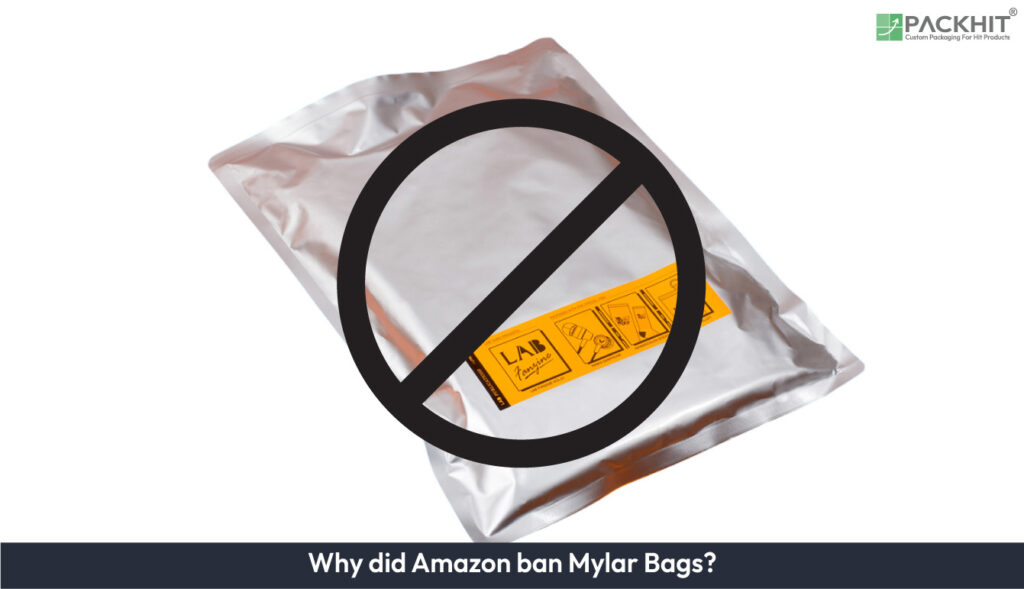
Mylar bags are not inherently restricted on Amazon; listing removals generally depend on how the bags are marketed, their stated intended use, and whether regulated claims are supported by appropriate evidence. Listings can face enforcement when they associate the packaging with cannabis or controlled substances, promote concealment or smell-proof use, or make food-contact, child-resistant, or tamper-evident claims without matching documentation.
- Which Mylar-Bag Variants Were Banned on Amazon?
- What Marketplace Policies Trigger the Removal of Mylar Bags from Amazon?
- How Does Amazon Enforce Listings for Packaging Products?
- What to Check Before Resubmitting Mylar Bag Packaging Listings?
- Where Can Mylar Bags Be Sold if Marketplace Restrictions Persist?
Which Mylar-Bag Variants Were Banned on Amazon?
Amazon removed Mylar-bag listings when the product page linked the pouch to controlled-substance use, regulated consumables, or concealment. Standard Mylar construction, by itself, does not trigger removal; enforcement targets the listing’s stated intended use, claim wording, and the compliance evidence shown in the offer.
- Cannabis or edible-branded bags: Mylar pouches marketed for marijuana, THC concentrates, or cannabis edibles, including listings that use cannabis graphics, strain names, “edible” wording, or “THC storage” positioning.
- Smell-proof pouches for concealment: Odor-resistant or odor-blocking pouches promoted as “weed bags,” “odorproof,” “smell-proof,” or “discreet” containers, especially when the page language connects odor reduction to hiding cannabis from others.
- Controlled-substance storage or concealment: Mylar bags sold for storing, transporting, packing, or concealing controlled substances rather than general-purpose food storage or ordinary retail packaging.
- Child-resistant or tamper-evident claims tied to regulated products: Listings that claim child-resistant performance or tamper evidence for cannabis or other regulated consumables when the offer does not include documentation that matches the claim scope.
- Drug-paraphernalia positioning: Offers that pair Mylar packaging with drug paraphernalia language, including “for glass,” “for cartridges,” or similar consumable-specific terms when the packaging is marketed as part of controlled-substance use.
Important distinction: General-purpose mylar bags for coffee, food ingredients, pharmaceutical secondary packaging, or non-regulated products remain allowed when the listing matches legitimate packaging use and the page supports the claimed contact category and safety expectations (for example, through migration-relevant documentation for stated food-contact use).
What Marketplace Policies Trigger the Removal of Mylar Bags from Amazon?
Amazon removes listings when moderation systems and reviewers associate the offer with cannabis or controlled-substance use, food-contact or sanitary compliance gaps, missing child-safety evidence, or concealment and smell-proof marketing. Removal also follows when titles, bullet points, images, and backend keywords place the pouch into restricted categories through sensitive product language.
- Controlled-substance association: Listings that explicitly mention cannabis, THC, “weed bags,” or drug-paraphernalia keywords, including combinations that describe storage “for” a controlled product.
- Food-contact and sanitary compliance gaps: Mylar pouches marketed for edible goods without listing the required food-contact support for the claimed use, including documentation that matches the stated test scope for migration and intended contact conditions.
- Child-resistant and tamper-evidence absence: Pouches marketed for regulated consumables with child-resistant or tamper-evident claims when the offer lacks test reporting that matches the claim type and performance category.
- Concealment and smell-proof claims: Terms and images that signal the container’s purpose as concealment, including “odor proof,” “smell-proof,” and discreet-resealable phrasing that links odor avoidance to hiding a controlled substance.
- Incorrect category or metadata: Titles, variant names, image captions, and search terms that map the packaging to restricted categories through sensitive language, even when the main description uses generic wording.
Trigger to evidence binding used by reviewers: when a page claims a function tied to regulation (food contact, child resistance, tamper evidence, or odor-concealment intent), the listing needs matching proof for that specific claim. Generic “certificates” that do not state the claimed scope do not address the trigger.
What are the Regulatory and Product-Safety Reasons Behind Enforcement?
Regulatory and product-safety enforcement helps ensure that packaging and products comply with marketplace rules, consumer-protection requirements, and applicable laws. Enforcement may address issues such as misleading claims, unsafe materials, prohibited uses, inadequate warnings, or missing compliance documentation. The specific requirements vary by product category, intended use, marketplace, and region, so listings should be supported by accurate product information and relevant safety or regulatory evidence.
How Does Amazon Enforce Listings for Packaging Products?
Amazon enforces packaging-related listings through automated checks and human review. Enforcement varies by marketplace region, product category, and the exact claim language used on a listing.
The enforcement workflow commonly follows these stages.
- Automated identification: Amazon systems screen listing text, image content, and structured attributes for restricted terms and mismatches. Common flags include food-use claims, cannabis or “weed” references, odor-control language, and child-resistant or tamper-evident wording. Signals combine keyword matches with image recognition results and attribute consistency checks. Example: a title that includes “edible” alongside photos showing packaged snacks triggers a food-use consistency review.
- Offer suppression and documentation request: If screening fails, Amazon may suppress purchase access while it requests documentation. Proof requests link to the claim category in the listing. For food-contact claims, Amazon requests food-contact migration evidence such as migration testing scope aligned to intended contact conditions. For child-resistant or tamper-evident language, Amazon requests performance evidence such as accredited test reports that match the claimed performance category. For odor-control or concealment language, Amazon requests technical evidence that covers barrier function and test scope under declared conditions. Some cases also ask for traceability items such as batch or lot identifiers and supplier invoices that tie materials to the shipped goods.
- Manual escalation and claim-to-evidence alignment: When automated screening and uploaded documents do not match, reviewers escalate for a deeper match. Reviewers check whether listing claims match technical evidence, including whether the test method and conditions cover the barrier function implied by the wording. Reviewers also check whether images and listed attributes match the offered packaging. Example: if a listing claims “smell-proof” for lawful odor control, reviewers expect barrier and odor-transfer evidence tied to conditions consistent with the declared use. Outcomes include extended suppression, removal from categories that require extra compliance, or additional account-level review steps.
Most packaging-related enforcement outcomes improve when sellers remove unsupported or restricted claims, correct listing metadata, update images, and submit traceability documentation that matches the product they ship. Prepare one evidence set per claim category and keep the scope consistent with the listing language. Use the same claim wording across listing copy, images, and submitted documents so reviewers can verify one-to-one alignment.
- Food-contact claim evidence: Provide food-contact migration documentation with test scope aligned to the intended contact conditions described on the listing.
- Child-resistant or tamper-evident claim evidence: Provide lab reports that match the claimed performance category and the claimed barrier or closure behavior.
- Odor-control and concealment claim evidence: Provide technical barrier or odor-transfer evidence that covers the function implied by the wording under declared conditions.
- Traceability and sourcing evidence: Provide supplier invoices and traceability identifiers such as batch or lot information that tie shipped materials to the submitted specifications.
- Material specification evidence: Provide polymer and barrier material specification sheets that match the film type and thickness stated in listing attributes.
Keep files ready such as third-party test reports, supplier invoices, polymer or barrier material specifications, and product photography that shows lawful uses. Example photo contexts include pet treat storage, coffee storage, or moisture protection for electronics shown in product photography.
What to Check Before Resubmitting Mylar Bag Packaging Listings?
Before resubmitting a Mylar bag packaging listing, review the intended use, product claims, images, metadata, technical evidence, and supplier records for consistency. The listing should clearly present the bags as lawful packaging and avoid wording or visuals that suggest concealment or illegal distribution.
- Intended-use labeling: Use specific, neutral applications such as long-term dry food storage or electronics moisture protection. Remove keywords that imply concealment or hidden transport.
- Food-contact documentation: If the listing claims food-contact suitability, provide the applicable migration-test results or supplier declaration. The documentation should identify the tested film structure and relevant food-contact category.
- Child-resistant claims: If child-resistant performance is claimed, provide an appropriate third-party test report or certificate and ensure it applies to the exact closure method shown in the listing images.
- Odor-control claims: Remove wording associated with concealment or illegal transport. Any odor-control claim should describe a legitimate storage application and be supported by documentation for the stated mechanism.
- Image compliance: Use neutral product and lifestyle images that show features such as the zipper, seal, dimensions, thickness, or material structure. Avoid imagery suggesting hidden compartments, disguises, or concealment.
- Metadata and category: Select an appropriate packaging category and ensure attributes accurately identify the material, thickness, dimensions, and closure type.
- Claims and evidence: Match barrier, safety, durability, and material claims to the technical documents submitted for the product. Avoid claims that extend beyond the documented test scope.
- Supplier traceability: Keep supplier invoices, batch identifiers, material-specification sheets, and relevant test reports together. The film grade and structure should remain consistent across these records.
- Resubmission consistency: Check that the SKU, unit of measure, pricing references, film grade, and thickness match the supplier and packing documents. For example, if the supplier specifies a 3.5, 5, or 7 mil structure, the listing should use the same specification.
These checks help ensure that the listing’s offer intent, claims, media, metadata, and supporting evidence tell the same story during a relisting or enforcement review.
Where Can Mylar Bags Be Sold if Marketplace Restrictions Persist?
Mylar bags can be sold through specialist packaging suppliers, B2B marketplaces, wholesale distributors, and a brand’s own ecommerce store, provided the products and listings comply with the applicable laws, platform policies, and intended-use requirements. Suitable channels may include packaging-focused websites, local distributors, trade suppliers, and direct business-to-business sales.
If restrictions persist on a major marketplace, the safer approach is to review the reason for enforcement, correct unsupported or prohibited claims, and choose a sales channel whose policies allow the specific packaging application rather than attempting to bypass marketplace controls.