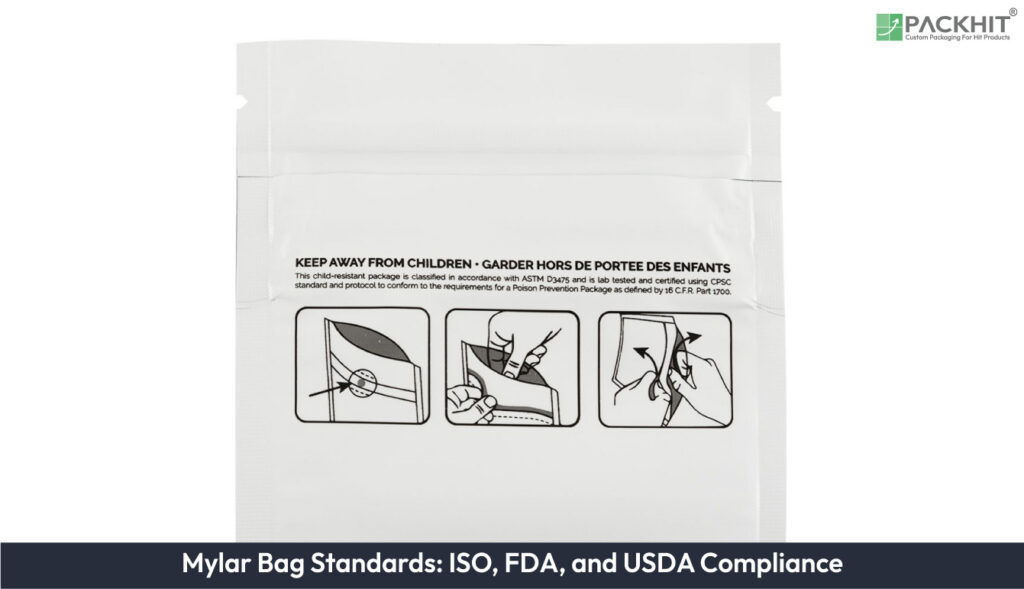
Mylar bag safety standards ensure material integrity, chemical safety, and barrier performance to protect packaged goods during storage and transport. Depending on the specific product and intended use case, compliance with ISO, FDA, and USDA regulations may be required to help support durability, food safety, and hygiene. Relevant ISO standards include ISO 9001 for quality management, ISO 14001 for environmental practices, and ISO 11607 for sterile packaging, focusing on performance metrics like tensile strength and permeability. FDA compliance (21 CFR Parts 174-178) mandates approved PET materials, chemical migration testing, and documentation to ensure food-contact safety, while USDA standards focus on sanitation, microbial resistance, and impermeability for meat, poultry, and dairy packaging. Because regulatory compliance alone does not guarantee shelf life, manufacturers must also perform application-specific testing, such as puncture resistance and seal integrity verification, to withstand real-world environmental stressors.
- What are Mylar Bag Safety Standards?
- ISO Standards Relevant to Mylar Bags
- ISO 9001: Quality Management Systems
- ISO 14001: Environmental Management
- ISO 11607: Sterile Packaging Requirements
- Performance Metrics Evaluated Under ISO Compliance
- Maintaining Certification and Periodic Audits
- How Does FDA Compliance Impact Mylar Bag Production?
- USDA Standards for Mylar Bags in Food Packaging
- What are the Implications of Non-Compliance with Mylar Bag Safety Standards?
- How Can Manufacturers Ensure Ongoing Compliance with Mylar Bag Safety Standards?
What are Mylar Bag Safety Standards?
Mylar bag safety standards encompass regulatory and performance criteria designed to ensure their suitability in packaging applications. These standards evaluate material integrity, chemical safety, and barrier properties to maintain product quality during storage and transportation. Compliance with safety protocols, including ISO benchmarks for material consistency, FDA regulations for food contact safety, and USDA guidelines for hygiene, guarantees that mylar bags meet required thresholds for durability, contamination prevention, and environmental sustainability.
For example, tensile strength testing can ensure structural reliability, while chemical migration studies verify that no harmful substances interact with packaged goods. Manufacturers must conduct routine audits and maintain meticulous records to support compliance inspections and certification validity. They must also conduct routine audits and maintain meticulous records. These steps are necessary to satisfy inspection demands and uphold certification validity.
ISO Standards Relevant to Mylar Bags
ISO standards relevant to mylar bags emphasize material quality, manufacturing consistency, and performance validation. These standards ensure that production methods align with globally recognized benchmarks, minimizing variability and defects.
ISO 9001: Quality Management Systems
ISO 9001 establishes protocols for quality management, requiring manufacturers to implement systematic controls throughout production. This standard ensures consistent material integrity and performance, reducing risks associated with defects or inconsistencies.
ISO 14001: Environmental Management
ISO 14001 mandates environmentally responsible practices, including sustainable material sourcing and waste management. Manufacturers must adopt measures to minimize ecological impact, ensuring compliance with environmental regulations.
ISO 11607: Sterile Packaging Requirements
ISO 11607 defines standards for packaging used in sterile medical devices. While this standard primarily applies to healthcare applications, its requirements for barrier properties and material performance may intersect with mylar bag use in pharmaceuticals.
Performance Metrics Evaluated Under ISO Compliance
Key attributes assessed during ISO compliance include tensile strength, moisture vapor transmission rate (MVTR), and oxygen permeability. These metrics are essential for determining the suitability of mylar bags in preserving product quality, particularly in food and pharmaceutical packaging.
Maintaining Certification and Periodic Audits
To maintain ISO certification, manufacturers must conduct regular audits and rigorous testing to verify adherence to defined parameters. This ongoing evaluation ensures alignment with ISO standards and safeguards product reliability.
How Does FDA Compliance Impact Mylar Bag Production?
FDA compliance impacts mylar bag production in multiple ways, given below:
- Regulatory Framework: The FDA regulatory framework governs packaging materials under Title 21 of the Code of Federal Regulations (CFR), specifically Parts 174 to 178. These sections define the permissible substances and additives in food-contact surfaces, ensuring safety and preventing contamination. Mylar bags used in food applications must be manufactured with FDA-approved polyethylene terephthalate (PET) films to prevent harmful chemical migration into the food during storage or transportation.
- Key Testing Requirements: FDA compliance involves rigorous testing protocols to validate material integrity and safety. These include chemical migration studies, thermal stability assessments, and tests for resistance to contamination. For instance, mylar bags intended for high-temperature applications, like sous vide cooking, must be tested for heat resistance and chemical inertness to ensure they meet safety standards.
- Documentation and Inspections: Maintaining detailed records of material composition, production processes, and testing results is a fundamental compliance pillar. This information is critical for facilitating FDA inspections and audits, ensuring transparency and adherence to regulatory requirements. Proper record-keeping also supports the renewal of certifications and helps address any compliance challenges proactively.
USDA Standards for Mylar Bags in Food Packaging
Adhering to USDA standards for mylar bags in food packaging is essential for ensuring product quality and safety.
Scope of USDA Regulations
The scope of USDA regulations encompasses the rigorous hygiene and safety standards required for packaging materials used in meat, poultry, and dairy products. Compliance is enforced through the Food Safety and Inspection Service (FSIS), which outlines requirements for materials to be non-toxic, durable, and impermeable.
Material Performance Criteria
Meeting material performance criteria is vital, with key requirements for mylar bags including resistance to punctures, microbial growth, and moisture ingress. These features are critical to maintaining product integrity during storage and transportation. For vacuum-sealed applications, low oxygen transmission rates are essential for preserving freshness and extending shelf life.
Facility and Operational Standards
Compliance with USDA sanitation standards is mandatory for facility operations. This requires implementing precise cleaning protocols and robust pest control measures to maintain certification and mitigate contamination risks.
Note: These are general compliance considerations, not a regulatory determination. Depending on the product, intended use, and applicable requirements, compliance with relevant FDA and USDA requirements can vary by food-contact application, material, process, and jurisdiction. Manufacturers and users must verify specific compliance requirements, jurisdiction-specific regulations, and application-specific standards directly with the relevant regulatory authorities and compliance professional prior to production or sale.
What are the Implications of Non-Compliance with Mylar Bag Safety Standards?
Non-compliance with mylar bag safety standards, ISO, FDA, and USDA, can have significant implications for manufacturers, including legal penalties, reputational damage, and financial losses. Products packaged in non-compliant mylar bags may be subject to recalls, leading to disruptions in supply chains and loss of consumer trust. Additionally, non-compliance can result in the suspension of manufacturing operations until corrective actions are implemented.
For example, failure to meet FDA chemical migration standards could lead to contamination of food products, posing health risks to consumers and triggering regulatory action. Similarly, non-compliance with USDA sanitation guidelines may result in the spread of foodborne illnesses, necessitating costly investigations and remediation efforts. Manufacturers must prioritize compliance to mitigate these risks and ensure the safety and quality of their products.
How Can Manufacturers Ensure Ongoing Compliance with Mylar Bag Safety Standards?
To ensure ongoing compliance with mylar bag safety standards, ISO, FDA, and USDA, manufacturers must use documented audits, testing, training, and regulatory-update procedures. Regular audits, both internal and external, are essential for identifying and addressing potential issues before they escalate. Investing in advanced testing equipment and training personnel in regulatory requirements can further enhance compliance efforts.
Manufacturers should also stay updated on changes to regulatory standards, as revisions may necessitate adjustments to production processes or material specifications. Collaborating with accredited testing laboratories and certification bodies can streamline compliance procedures, ensuring that mylar bags meet all applicable standards. By maintaining a proactive approach to compliance, manufacturers can safeguard their operations and uphold the integrity of their products.