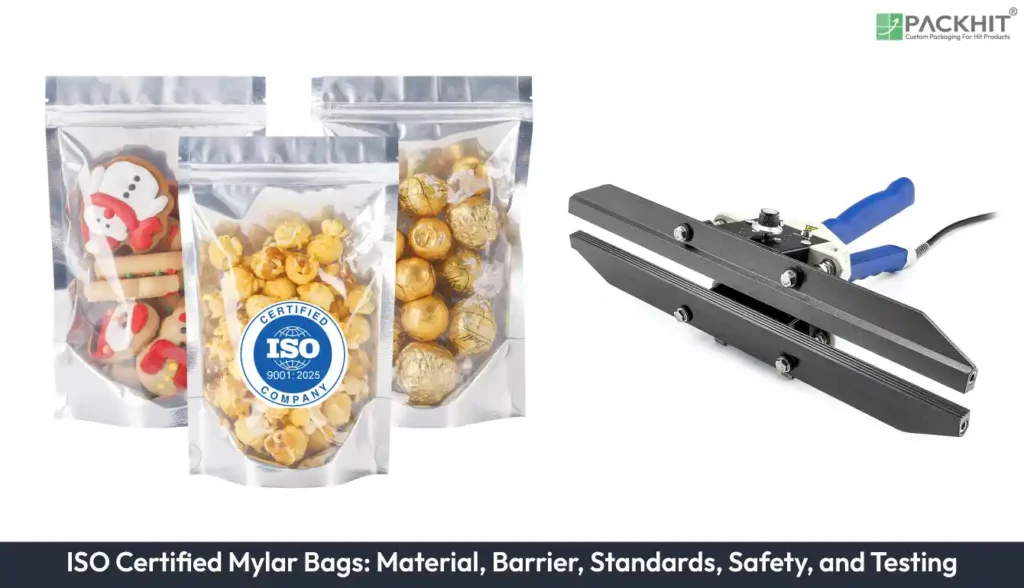
ISO-certified mylar bags are high-performance, multilayer packaging materials (primarily BoPET combined with aluminum or polyethylene) that provide exceptional barriers against oxygen, moisture, and UV light. Manufactured under strict global standards like ISO 9001, 14001, 22000, and 15378, these bags range from 2.5 to 7 mils in thickness and are thoroughly tested for mechanical strength, chemical stability, and long-term shelf life. Designed for food, pharmaceutical, and industrial use, they feature advanced safety options such as chemical resistance, tamper-evidence, and child-resistant designs, though buyers must always verify specific regulatory compliance and application suitability through current manufacturer documentation.
- What are ISO-Certified Mylar Bags?
- Material Composition of ISO-Certified Mylar Bags
- Primary Polymer Layer
- Structure and Barrier Function
- UV and Chemical Resistance
- Thickness Ranges and Typical Uses
- Food‑Grade and Pharmaceutical Specifications
- How do Barrier Properties Enhance the Quality of ISO-Certified Mylar Bags?
- Oxygen Barrier Performance
- Water‑Vapor Barrier Performance
- UV and Light Protection
- Seal Integrity and Headspace Control
- Testing and Specification
- Which ISO Standards and Tests Apply to Mylar Bag Manufacturing?
- Safety Features Integrated into ISO-Certified Mylar Bags
- Testing Protocols that Validate the Quality of ISO-Certified Mylar Bags
- Why are ISO-Certified Mylar Bags Essential for Manufacturers?
What are ISO-Certified Mylar Bags?
ISO-certified mylar bags are specialized packaging solutions made from biaxially-oriented polyethylene terephthalate (BoPET), often combined with additional layers like aluminum foil or polyethylene. Depending on the specific construction, these materials can support strength, chemical resistance, and barrier performance against oxygen, moisture, and light. ISO certifications such as ISO 9001 for quality management, ISO 14001 for environmental impact, and ISO 22000/15378 for food and pharmaceutical safety apply to manufacturer management systems, not directly to the finished product, which undergoes separate testing to meet industry-specific requirements.
How is ISO Certification Achieved?
ISO certification is achieved through a comprehensive series of audits and assessments conducted by accredited third-party organizations. To earn certification, manufacturers must:
- Demonstrate strict compliance with relevant ISO standards.
- Validate their manufacturing processes.
- Maintain thorough, auditable documentation.
- Implement robust quality management systems.
ISO certifications do not automatically prove that a finished bag is suitable for food, pharmaceutical, child-safety, or other regulated applications. Before use, it is necessary to directly verify the following with the manufacturer or a qualified professional:
- Bag composition and materials
- Intended-use documentation and test results
- Closure features
- Specific regulatory requirements
Material Composition of ISO-Certified Mylar Bags
The material composition of ISO-certified mylar bags relies on key component layers from manufacturers operating under relevant ISO-certified systems is given below:
Primary Polymer Layer
The primary polymer layer, typically consisting of BoPET (biaxially-oriented polyethylene terephthalate), provides tensile strength, chemical resistance, and thermal stability. The biaxial orientation aligns polymer chains in two perpendicular directions, increasing mechanical strength and dimensional stability. Manufacturers combine BoPET with additional layers such as aluminum foil or polyethylene to achieve required functional properties.
Structure and Barrier Function
Structure and barrier function in these packaging solutions are achieved by using multilayer laminates with BoPET plus metallized or foil layers to reduce oxygen, moisture, and light ingress. Metallized or aluminum foil layers lower oxygen transmission and water-vapor transmission. Polyethylene layers help add heat-sealability and puncture resistance. Examples include metallized BoPET for retail pouches and foil-PE laminates for long-term storage.
UV and Chemical Resistance
UV and chemical resistance are critical performance attributes inherent in mylar constructions, which withstand common acids, bases, and solvents used in packaging environments. UV-stable films prevent photodegradation of sensitive contents such as vitamins and essential oils. Chemical resistance depends on layer choice. For example, BoPET resists solvents better than plain polyethylene.
Thickness Ranges and Typical Uses
Thicknesses and typical uses for these bags generally range from 2.5 to 7 mils; choose thinner films for lightweight packaging and thicker films for industrial or long-term storage. Typical selections: 2.5-3 mils for single-use retail pouches, 4 mils for refillable consumer packaging, 5-7 mils for heavy-duty or long-storage applications.
Food‑Grade and Pharmaceutical Specifications
Food-grade and pharmaceutical specifications ensure that these formulations use specified raw materials, adhesives, and inks to prevent chemical leaching and meet contact-safety requirements. These grades follow defined material declarations and purity limits used in direct-contact applications, for example, food-grade adhesives and pharmacopeial raw-material specifications.
How do Barrier Properties Enhance the Quality of ISO-Certified Mylar Bags?
Barrier properties improve mylar bag quality by limiting the transfer of oxygen, moisture, light, and odors, which protects product condition and supports a consistent shelf life when the film structure and seals meet the packaging specifications.
Oxygen Barrier Performance
Oxygen barrier performance determines suitability for oxygen‑sensitive products. It is measured as oxygen transmission rate (OTR). An aluminum foil layer reduces OTR to <0.1 cc/m²/day. Metallized BoPET laminates typically measure 0.5-2 cc/m²/day. Manufacturers verify OTR using ASTM D3985 (coulometric method). Typical applications: roasted coffee, vacuum‑packed spices, and oxygen‑sensitive pharmaceuticals.
Water‑Vapor Barrier Performance
Water‑vapor barrier performance protects moisture-sensitive items like dry medicines, powders, and chemicals from absorbing water and clumping together. It tracks how much moisture leaks through the packaging material each day. Different materials offer different levels of defense: foil-polyethylene laminates provide the strongest barrier, metallized films offer moderate protection, and plain plastics provide the least. To guarantee these bags can safely preserve vulnerable items, industry professionals standardly test them using a rigorous, universally recognized method known as ASTM F1249.
UV and Light Protection
UV and light protection properties are essential for preventing the photodegradation of light‑sensitive compounds. Metallized or foil layers block >99% of UV and visible light, producing near‑opaque pouches. Clear BoPET with UV‑absorbing coatings reduces UV transmission but does not match foil opacity. Products that benefit: vitamins, essential oils, and light‑reactive pharmaceutical APIs.
Seal Integrity and Headspace Control
Seal integrity and headspace control work in tandem to preserve the internal atmosphere and prevent ingress. Heat seals must pass peel and leak tests to confirm hermetic closure. Complementary controls include nitrogen flushing, vacuum packaging, oxygen scavengers, and desiccant packets. Typical examples include iron‑based scavengers and silica gel desiccants. Add oxygen scavengers if the target residual oxygen must be below 0.1%.
Testing and Specification
Testing and specification protocols are required to validate barrier claims through laboratory verification with standard tests. Core tests include ASTM D3985 for OTR and ASTM F1249 for WVTR. Accelerated aging at elevated temperature and humidity is used to stress materials. Common stressors are 40°C/75% RH for 4-8 weeks. Use these test results to specify laminate construction, required layers, and expected shelf life for specific products.
Which ISO Standards and Tests Apply to Mylar Bag Manufacturing?
Manufacturers of mylar bags may hold various ISO certifications for management systems covering quality, environmental practices, food safety, or pharmaceutical packaging processes. These certifications describe the applicable management system. They do not by themselves prove that every finished bag meets a specific application, safety, or regulatory requirement.
- Quality Management Standards: ISO 9001 is the primary quality management standard applied to mylar bags. It requires manufacturers to establish a robust quality management system, including regular inspections and corrective actions. This can indicate that the manufacturer follows a documented management system when the certification applies.
- Environmental Management Standards: Compliance with ISO 14001 ensures that mylar bag production adheres to environmental management protocols. This includes the use of sustainable materials, energy-efficient manufacturing practices, and proper waste management, reducing the ecological footprint of the packaging process.
- Food Safety and Pharmaceutical Standards: For food-grade mylar bags, ISO 22000 certification indicates that the manufacturer follows defined management processes for food safety. Pharmaceutical-grade mylar bags may follow ISO 15378, which outlines management system requirements for primary packaging materials used in medicinal products. Both standards outline framework criteria to support safety and regulatory compliance processes.
Whether a mylar bag is suitable for a particular food, pharmaceutical, or industrial use depends on its material construction, supplier documentation, applicable requirements, and product-specific testing. Ask the manufacturer which certifications and test results apply to the finished bag.
Safety Features Integrated into ISO-Certified Mylar Bags
Features integrated into ISO-certified mylar bags are a cornerstone of their design, particularly for applications involving food and pharmaceuticals. These bags are designed to be non-toxic, odorless, and resistant to chemical leaching. The use of food-grade adhesives and inks further minimizes the risk of contamination, ensuring that the packaging does not compromise the safety of the contents.
In addition to material safety, the structural integrity of mylar bags is rigorously tested to prevent punctures, tears, and leaks. Features such as heat-sealable closures and tamper-evident designs enhance security, making the bags suitable for high-risk applications. For instance, pharmaceutical-grade mylar bags often include child-resistant closures to prevent accidental ingestion.
How Do Mylar Bags Address Environmental Safety?
Mylar bags address environmental safety by complying with ISO 14001 standards. This includes the use of recyclable materials, reduced energy consumption during manufacturing, and adherence to waste management protocols. Some manufacturers offer biodegradable or compostable variants to further minimize environmental impact.
Testing Protocols that Validate the Quality of ISO-Certified Mylar Bags
Testing protocols that validate the quality of ISO-certified mylar bags comprise a series of standardized tests designed to assess their physical, chemical, and functional properties. These tests include tensile strength measurements, puncture resistance evaluations, and barrier property assessments. For example, tensile strength tests determine the maximum force the material can withstand before breaking, ensuring durability during handling and storage.
Chemical resistance tests evaluate the material’s ability to withstand exposure to acids, bases, and solvents, a critical factor for industrial applications. Barrier property tests, such as OTR and WVTR measurements, confirm the bag’s effectiveness in protecting contents from environmental factors.
What Role Does Accelerated Aging Play in Testing?
Accelerated aging plays a critical role in testing by simulating long-term storage conditions to evaluate the durability and performance of mylar bags over time. These tests expose the bags to elevated temperatures, humidity levels, and UV radiation to predict their lifespan and identify potential failure points. The results provide valuable data for manufacturers and end-users, ensuring that the bags meet the required performance standards for their intended applications.
Why are ISO-Certified Mylar Bags Essential for Manufacturers?
ISO-certified mylar bags are essential for manufacturers because they are a compliant packaging solution with specified material properties and testing processes. Their suitability depends on the laminate construction, barrier tests, closure design, applicable compliance documentation, and the intended use and storage conditions. Manufacturers should match the laminate construction, barrier tests, closure design, and applicable compliance documentation to the intended use. This comparison can help determine whether the packaging fits the product and storage conditions.
