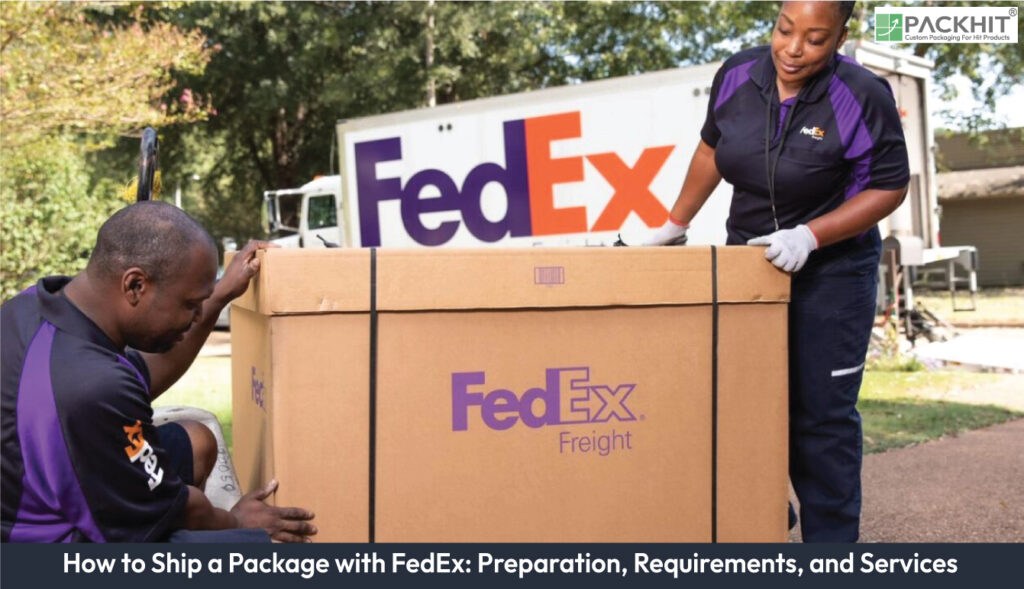
Prepare a FedEx shipment in nine steps by selecting services such as Ground, Express, or Freight, inspecting the weight, dimensions, and fragility of the item, choosing reinforced outer packaging, adding cushioning and void fill, sealing the package with H-pattern tape, weighing and measuring the final package, declaring the value and any additional services, arranging for pickup or drop-off, and tracking the delivery to its destination. FedEx enforces specific packaging requirements focused on durability and dimensional weight, which influences shipping costs based on a package’s size and weight. Recommended materials include corrugated boxes, reinforced paper packaging, and protective cushioning. FedEx offers various shipping services such as Ground, Express, 2Day, and Overnight, each suited to different delivery speeds and product needs.
Rates depend on weight, size, destination, and optional services, with surcharges for oversized or special-handling shipments. FedEx’s advanced tracking system provides real-time shipment updates and proactive notifications. Return shipping options include Ground and Express Returns with customizable features like prepaid labels and scheduled pickups. Manufacturers can optimize FedEx shipping through smart packaging, service selection, integration tools, and eco-friendly practices.
- Step-by-Step Guide to Preparing a Package for FedEx Shipping
- Step 1: Select the FedEx service
- Step 2: Inspect the product
- Step 3: Pick the right outer packaging
- Step 4: Add cushioning and void fill
- Step 5: Seal and mark the package
- Step 6: Weigh and measure accurately
- Step 7: Declare value and add services
- Step 8: Choose pickup or drop-off
- Step 9: Track and confirm delivery
- What Are FedEx’s Packaging Requirements?
- What Shipping Services Does FedEx Offer?
- How Are FedEx Shipping Rates Calculated?
- How Does FedEx Tracking Work?
- What Are FedEx’s Return Shipping Options?
- How Can Manufacturers Optimize Shipping with FedEx?
Step-by-Step Guide to Preparing a Package for FedEx Shipping
Follow these steps to prepare a FedEx shipment.
Step 1: Select the FedEx service
Select a service based on delivery time and cost. Use FedEx Ground for 1–5 business-day domestic delivery. Use FedEx Express for next-business-day options. Use FedEx Freight for single pieces over 150 lb. Choose international air or ocean services for cross-border shipments.
Step 2: Inspect the product
Confirm weight, dimensions, and fragility. Record any pre-existing damage. If you ship alcohol, follow FedEx alcohol program rules and ship only from licensed businesses when allowed.
Step 3: Pick the right outer packaging
Use corrugated boxes for rigid protection or reinforced paper packaging tested for compression. Size the box to reduce empty space. Double-box fragile items for added protection.
Step 4: Add cushioning and void fill
Wrap items with bubble wrap, foam, or kraft paper. Fill all voids to prevent movement. Use corner protection for flat or thin items.
Step 5: Seal and mark the package
Seal all seams with 2-inch packing tape applied in an H pattern. Apply clear shipping labels on the largest flat face. Add handling labels such as FRAGILE or THIS SIDE UP when needed.
Step 6: Weigh and measure accurately
Weigh the package on a calibrated scale. Measure length, width, and height in inches. Calculate dimensional weight as (L × W × H) ÷ 139 for U.S. domestic shipments.
Step 7: Declare value and add services
Declare the shipment value. FedEx includes $100 declared value coverage by default. Purchase additional coverage up to $50,000 for high-value items. Request signature proof of delivery if required.
Step 8: Choose pickup or drop-off
Schedule a FedEx pickup or drop off at a FedEx location. FedEx delivers on Saturday and Sunday in eligible areas. Use a local shipping center for service and rate comparisons if needed.
Step 9: Track and confirm delivery
Use the FedEx tracking number to monitor transit. Enable email or SMS notifications for delivery updates. Keep the proof of delivery for claims or records.
What Are FedEx’s Packaging Requirements?
FedEx mandates strict packaging standards to ensure the safe and efficient transport of goods. Packages must be durable enough to withstand handling and transit conditions, with rigid boxes being preferred for their structural integrity. The company calculates shipping costs based on dimensional weight, which considers both the size and weight of the package. This approach incentivizes the use of compact and lightweight packaging to minimize costs. For manufacturers using paper-based packaging, it is essential to ensure that the materials are sufficiently reinforced to meet FedEx’s durability criteria.
Dimensional Weight and Its Impact
Dimensional weight is a critical factor in FedEx’s pricing model. It is calculated by dividing the package’s volume (length × width × height) by a dimensional factor, typically 139 for domestic shipments. Larger packages with low physical weight may incur higher shipping costs due to their volumetric footprint. Manufacturers should optimize packaging designs to reduce unused space while maintaining product protection.
Recommended Packaging Materials
FedEx recommends using corrugated cardboard boxes, reinforced paper-based materials, and cushioning elements such as bubble wrap or foam inserts. For fragile items, double-boxing is advised to provide an additional layer of protection. Paper-based packaging solutions should be tested for compression strength and puncture resistance to ensure compliance with FedEx’s standards.
What Shipping Services Does FedEx Offer?
FedEx provides a range of shipping services designed to accommodate varying delivery speeds, package sizes, and destinations. These services include FedEx Ground, FedEx Express, FedEx 2Day, and FedEx Overnight, each tailored to specific logistical needs. Manufacturers can select services based on urgency, cost considerations, and the nature of the goods being shipped.
FedEx Ground
FedEx Ground is ideal for non-urgent shipments, offering delivery within 1–5 business days across the United States. It is a cost-effective option for manufacturers shipping bulk goods or less time-sensitive products.
FedEx Express and Overnight Services
FedEx Express provides expedited delivery options, including FedEx Overnight, which guarantees next-business-day delivery. These services are particularly beneficial for manufacturers handling perishable goods or high-value items requiring immediate delivery.
FedEx 2Day
FedEx 2Day offers delivery within two business days, balancing speed and cost. It is suitable for shipments that require faster delivery than ground services but do not necessitate overnight shipping.
How Are FedEx Shipping Rates Calculated?
FedEx shipping rates are determined by several factors, including dimensional weight, delivery speed, destination, and additional services such as insurance or signature confirmation. Manufacturers can use the FedEx Rate Calculator to estimate costs based on package dimensions, weight, and service type.
Additional Charges
FedEx applies surcharges for oversized packages, residential deliveries, and shipments requiring special handling. Manufacturers should account for these fees when budgeting for logistics expenses.
How Does FedEx Tracking Work?
FedEx’s tracking system provides real-time updates on shipment status, enabling manufacturers to monitor the progress of their packages from origin to destination. Tracking numbers are assigned to each shipment and can be accessed via the FedEx website or mobile app.
Tracking Features
FedEx tracking includes detailed information such as estimated delivery times, transit locations, and delivery confirmations. Advanced tracking technologies, including GPS and RFID, enhance visibility for high-value or time-sensitive shipments.
Proactive Notifications
FedEx offers proactive notifications via email or SMS, alerting manufacturers to potential delays or delivery updates. This feature is particularly useful for managing customer expectations and coordinating logistics operations.
What Are FedEx’s Return Shipping Options?
FedEx provides a range of return shipping services that enable manufacturers to efficiently handle product returns due to defects, warranty claims, or customer dissatisfaction. These services include FedEx Ground Returns and FedEx Express Returns, which cater to varying logistical needs and delivery speeds.
FedEx Ground Returns
FedEx Ground Returns offer a cost-effective solution for handling non-urgent return shipments. This service is ideal for manufacturers managing bulk returns or items requiring standard transit times. Packages are delivered within 1–5 business days, ensuring reliable and consistent handling.
FedEx Express Returns
FedEx Express Returns provide expedited options for return shipments that require faster delivery. This service is suited for high-value or time-sensitive items, offering next-business-day delivery with enhanced tracking capabilities for greater accountability.
Return Label Generation
Manufacturers can generate return labels through the FedEx website or by integrating FedEx tools into their e-commerce platforms. Prepaid return labels simplify the process for customers, ensuring seamless tracking and efficient management of returned goods.
Customizable Return Solutions
For businesses with unique logistics requirements, FedEx offers customizable return shipping solutions, including scheduled pickups, flexible delivery options, and tailored packaging recommendations. These features allow manufacturers to optimize their return processes while maintaining product integrity.
How Can Manufacturers Optimize Shipping with FedEx?
To maximize efficiency and cost-effectiveness, manufacturers should focus on packaging optimization, service selection, and leveraging FedEx’s technological tools. Using compact, lightweight packaging reduces dimensional weight costs, while selecting appropriate service tiers ensures timely delivery without unnecessary expenses.
Integration with FedEx Tools
FedEx offers integration tools such as FedEx Ship Manager and APIs for automating shipping processes. These tools enable manufacturers to streamline label generation, tracking, and rate calculations, reducing manual effort and improving operational efficiency.
Sustainability Considerations
Manufacturers can align with FedEx’s sustainability initiatives by using eco-friendly packaging materials and optimizing shipping routes. FedEx’s carbon-neutral shipping options further support environmentally responsible logistics practices.